
Kelly Thornhill, founder of Adventures in Spanish and home-educating parent, shares how to fit Spanish into a busy UK home-education week: daily routine anchors, the 80/20 rule, one speaking slot, and Duolingo’s limits.
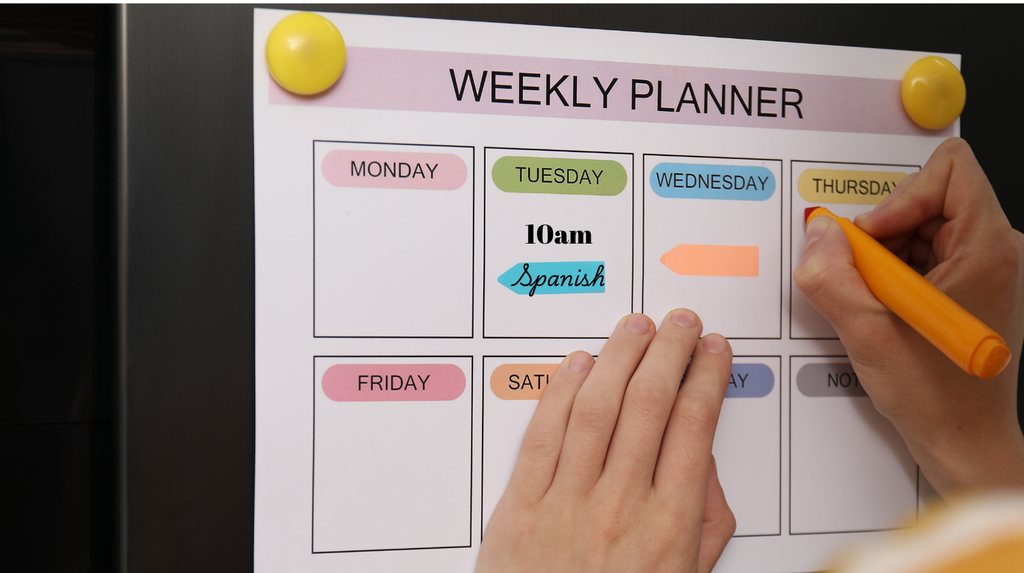
I once made a laminated timetable. Colour-coded, a little sun sticker on Fridays — and there, in the Tuesday 10am slot, in capital letters: SPANISH. This was our first stretch of home educating after we moved back to the UK, and after years in South America where Spanish had just… happened. It was at the verdulería — the little corner fruit and veg shop — and on the bus, and in the queue at the bakery. Nobody ever had to schedule it. And now here I was back in Cheshire (North West England), trying to squeeze it into a box between maths and lunch. (A box that got bumped by the dentist in week two and was quietly abandoned by week three. I know. I know.) If you’re right at the beginning, I’ve written about how to help your child start confidently with Spanish. This post is for the next problem. The one where you’ve got the books, the good intentions, maybe even a laminator… and Spanish keeps sliding off the week.
Because home-schooling weeks are full. Full of maths that won’t wait, swimming lessons, forest school, the co-op, the dentist, the day everyone’s just a bit off. Spanish is usually the first thing to go — not because you don’t care, but because it feels optional in a way that reading doesn’t.
So here’s what twenty-odd years in South America (and a lot of getting it wrong first) taught me about making it stick.
Why does Spanish keep falling off the timetable?
Mostly because we treat it like a subject. A block. Something with a start time and an end time, like long division.
But languages don’t really work like that. They work more like a sourdough starter. (Stay with me.) A little attention every day beats one big feed on a Tuesday. Fifteen minutes a day, five days a week, is 75 minutes — and it’ll do far more than a single hour-long block, because your child’s brain gets five chances to remember instead of six days to forget.
The other thing that helped me — eventually! — was the 80/20 rule. It’s the idea that a small slice of the language does most of the heavy lifting. A few hundred high-frequency words and phrases — quiero (I want), tengo (I have), ¿dónde está? (where is it?), me gusta (I like it) — cover a huge chunk of everyday conversation. I’ve gone into how the 80/20 rule works for learning Spanish in more detail here, but the short version for a busy week is this: stop trying to cover everything. Cover the things your child will actually say.
When I worked as a translator on horseback rides through the Andes, nobody needed the subjunctive halfway up a mountain. They needed left, right, stop, is the horse okay — and ¿cuánto falta? (how much further?), which I must have translated a hundred times a day!! That’s 80/20 in its purest form. Real Spanish, for real moments.
And apps? I get asked about Duolingo constantly — usually by a parent whose child has a 200-day streak and still freezes when I say hola. My honest answer: it’s a decent warm-up, and the streak is brilliant for motivation, but it won’t make your child speak. Tapping the right answer isn’t the same as building a sentence out loud for a real human being. In a busy week, I’d treat it as the five-minute filler, not the main event.
Three anchors that actually hold
Here’s the shift that finally worked in our house. Instead of finding time for Spanish, attach it to things that are already happening. Anchors. Things you do anyway.
1. Food — because you’re eating anyway. Breakfast is el desayuno, and the afternoon snack is la merienda — which in Argentina is practically sacred, tea and medialunas (little sweet croissants) at five o’clock, no exceptions. Pick one meal a day where the food words are in Spanish. Pass the pan. More leche? It feels silly for about a week, and then it’s just how you talk at breakfast. Once a fortnight, cook something together — empanadas are very forgiving, and counting out twelve discs of dough is maths too (home-ed bonus points!!).
2. The car — because you’re driving anyway. If your week looks anything like mine does now, you spend half your life on the A499. That’s hours of captive audience. Spanish songs, a kids’ podcast, or a round of veo veo — it’s I spy, the kids will crack the rules in about thirty seconds. Nobody has to sit at a table. Nobody has to get a pencil.
3. One speaking slot — because this one’s non-negotiable. Everything above is input. Lovely, necessary input. But children only really get confident when they have to use their Spanish with someone who isn’t you. A tutor, a live class, an online exchange, a Spanish-speaking neighbour — it doesn’t matter which. It doesn’t have to be long, either. Forty-five minutes once a week, protected the way you protect the swimming lesson, gives all those little bits from the rest of the week somewhere to go.
And for those of us in Wales, there’s a lovely bonus. Loads of our children already live between two languages — Welsh with Nain, English with friends, or the other way round. They’re switching languages before breakfast without thinking about it. Spanish isn’t even as far away as it looks: Welsh is still spoken in Patagonia, in towns like Gaiman and Trelew, where the first Welsh settlers landed in 1865. The tea rooms there serve torta galesa — “Welsh cake”, supposedly, although it’s really a dark fruit cake (don’t argue with the Patagonians about this — I tried). A Welsh child learning Spanish is joining a conversation that’s been going on for 160 years.
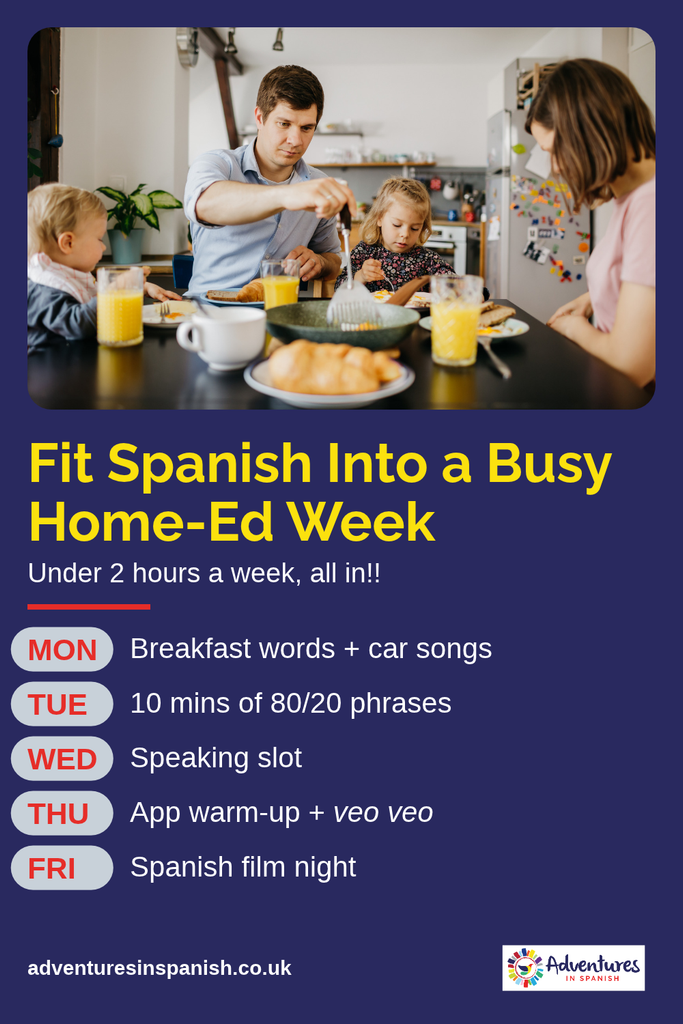
So what does a realistic week look like? Something like this:
- Monday — breakfast words in Spanish, Spanish songs in the car
- Tuesday — ten minutes of 80/20 phrases (five new, five old)
- Wednesday — the speaking slot
- Thursday — app warm-up and a round of veo veo
- Friday — film night with Spanish audio and English subtitles, or empanada day
Under two hours, all in. Most of it while you were doing something else.
And on the weeks it all falls apart (there will be weeks — there were plenty that first year back), do one thing. One merienda in Spanish. One song in the car. Poco a poco — little by little — is how my girls got there, and honestly? It’s how I got there too.
So tell me — where does Spanish fit in your week right now? Is it a block that keeps getting bumped, or have you already found an anchor that works?