

A complete guide to Mexico’s Día de los Muertos: its Aztec and Catholic origins, ofrenda symbolism, sugar skulls, La Catrina, Monarch butterflies, where to experience it, and Spanish-learning activities, recipes and films for children.
Every October, without fail, someone in one of my Spanish classes picks up a sugar skull, turns it over, and asks: “Isn’t this a bit… creepy?”
Fair question!! I thought the same the first time I read about families having picnics on graves. It sounded morbid. It isn’t – not even slightly. Día de los Muertos (the Day of the Dead) is about welcoming loved ones home for a couple of days each year, with music, marigolds and an awful lot of food.
I should be honest from the start – I’ve never actually been in Mexico for it. (Twenty years in South America, and I somehow never made it north for the first week of November. It’s very high on my list.) What I have done is teach it every single autumn since 2014, and write a children’s book about it with Jude Lennon. So this guide is everything I’ve pulled together along the way: where the festival comes from, what goes on a family altar, who that elegant skeleton lady is, and my favourite ways to share it with children. ¡Vámonos! – let’s go!
What is the Day of the Dead – and when is it?
El Día de los Muertos is Mexico’s festival for remembering family members who have died. It runs from 31st October to 2nd November, and it lines up with the Catholic feasts of All Saints’ Day and All Souls’ Day.
The days have their own jobs:
- 31st October – the night the gates between the worlds are believed to open
- 1st November – the spirits of children, los angelitos (the little angels), come home first
- 2nd November – the adults follow, and families head to the cemeteries
And no – it isn’t Mexican Halloween!! Halloween is about scares and costumes. Día de Muertos is about family. If you want the full side-by-side (plus how Spain marks the same dates, and the Spanish words you’ll need for both), I’ve put it all in Halloween vs Día de Muertos.
Where does the Day of the Dead come from?
It’s far older than most people realise. The Aztecs, Maya and Toltecs all honoured their dead, and they didn’t see death as an ending – more a move into another realm. The Aztecs even had a goddess for it, Mictecacíhuatl, the Lady of the Dead, and held a month-long festival for her in late summer.
Then in the 16th century the Spanish arrived, bringing Catholicism and doing their best to stamp out “pagan” rituals. It didn’t work – not completely. Over time, the old traditions slid quietly onto the Catholic calendar, landing on All Saints’ and All Souls’ Day. What you see today is a blend of both, which is exactly what makes it so fascinating to teach.
In 2008, UNESCO added the festival to its list of the world’s Intangible Cultural Heritage. Not bad for something the conquistadors tried to get rid of!!
The ofrenda – the heart of it all
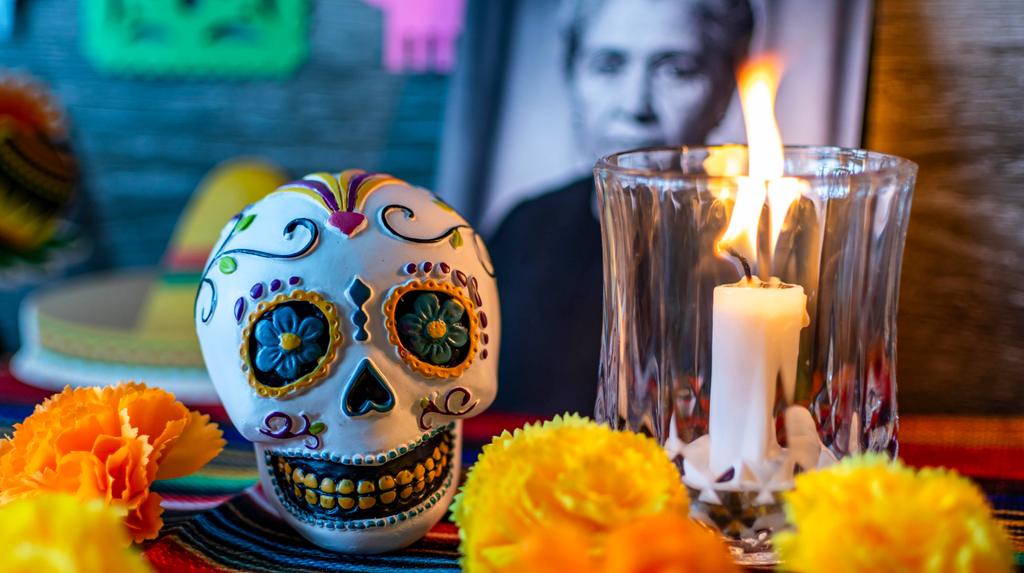
At the centre of every family’s celebration is the ofrenda – the altar (literally “offering”). Families build them at home, in cemeteries, even in town squares, and pile them high with photos of the people they’ve lost, their favourite food and drink, candles, flowers and sugar skulls. Grandad liked a particular brand of beer? It goes on. Your aunt couldn’t resist tamales? On they go too.
Many ofrendas are built in three tiers, often said to stand for heaven, earth and the underworld. Strung over the top you’ll usually see papel picado – bright tissue-paper banners with patterns cut right through them.
Every single thing on the altar means something:
| On the altar | In Spanish | What it’s there for |
|---|---|---|
| Marigolds | el cempasúchil | Their colour and strong scent guide the spirits home (it’s a Nahuatl word, from the Aztec language) |
| Candles | las velas | Fire – lighting the way |
| Water | el agua | Quenches the spirits’ thirst after the long journey, and stands for purity |
| Salt | la sal | Purifies |
| Bread of the dead | el pan de muerto | A sweet bun topped with dough “bones” – sharing and fraternity |
| Cut-paper banners | el papel picado | Wind – and the fragility of life |
| Sugar skulls | las calaveras de azúcar | The loved ones being remembered, often with their names on |
| Photos | las fotos | So everyone knows who the altar is for |
I love asking children what they’d put on an ofrenda for someone they miss. A grandparent’s favourite biscuits, a pet’s old collar… it gets them talking about remembering people in a really gentle way.
Sugar skulls, cheeky poems and La Catrina
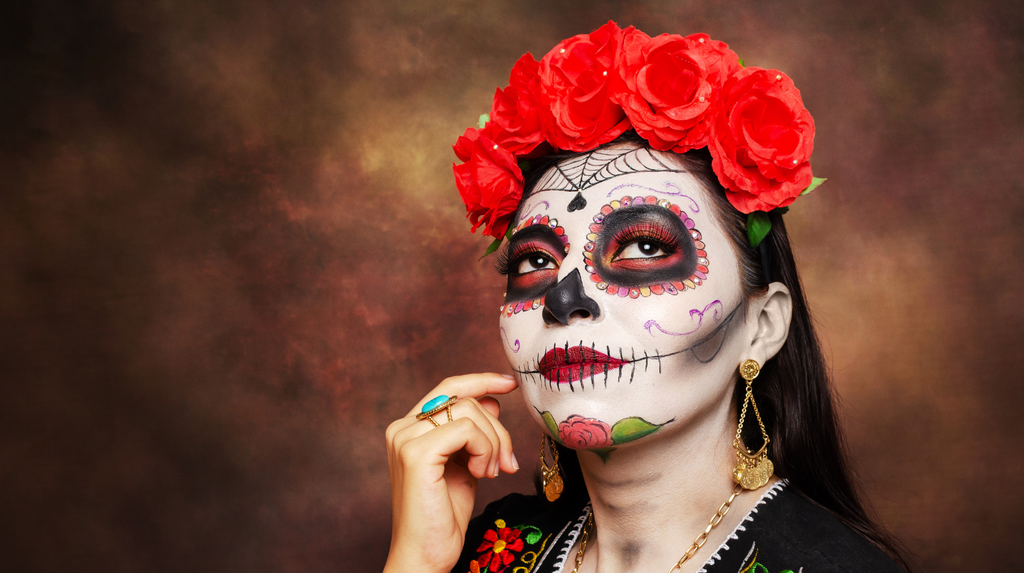
Skulls are everywhere during Día de Muertos – but they’re grinning, not grim. Calaveras de azúcar (sugar skulls) are made from sugar paste, decorated with icing flowers, hearts and swirls, and often have a name written across the forehead. Sometimes it’s the name of someone who’s died. Sometimes it’s a friend who’s very much alive (which my students find hilarious).
That sense of humour runs right through the festival. There’s even a tradition of writing calaveritas – little skull poems – that tease a living friend about their imaginary “death”. All affection, honestly!!
Who is La Catrina?
She’s the elegant skeleton lady in the enormous feathered hat, and you’ll see her on everything from posters to face paint. But she started life as a joke at the rich.
In the early 1900s, the Mexican cartoonist José Guadalupe Posada made an etching of a skeleton in a fancy European-style hat. He was mocking wealthy Mexican women who copied French fashion – the point being that under the finery, we all end up the same. Decades later, in 1947, the painter Diego Rivera put her in his huge mural Dream of a Sunday Afternoon in the Alameda Park, gave her the name La Catrina (catrín means a well-dressed dandy), and placed her arm in arm with Mexicans from every walk of life.
That’s what turned her from a satire into an icon. Today she stands for exactly what the festival is about – death comes to everyone, so you might as well dance with it.
The Monarch butterflies (and Frida)
This is my favourite bit of the whole festival – and it’s the reason I ended up writing a book.
Every autumn, millions of Monarch butterflies (la mariposa monarca) fly from Canada and the eastern USA all the way to the mountain forests of central Mexico – up to around 4,000 kilometres, on wings that weigh less than a paperclip. They’re the only butterfly known to make a two-way migration, like birds. And the first big wave tends to arrive in late October and early November… right around Día de los Muertos. In Mexico, some people believe the butterflies carry the souls of loved ones coming home.
When I found that out, I was hooked. I’d met children’s author Jude Lennon in October 2015, and we’d got talking about how impossible it was to find a decent bilingual book about the Day of the Dead in the UK. The ones I’d found were either really expensive or (I’ll be kind) not very good. A butterfly racing to get to Mexico in time for the celebrations? That had to be our story.
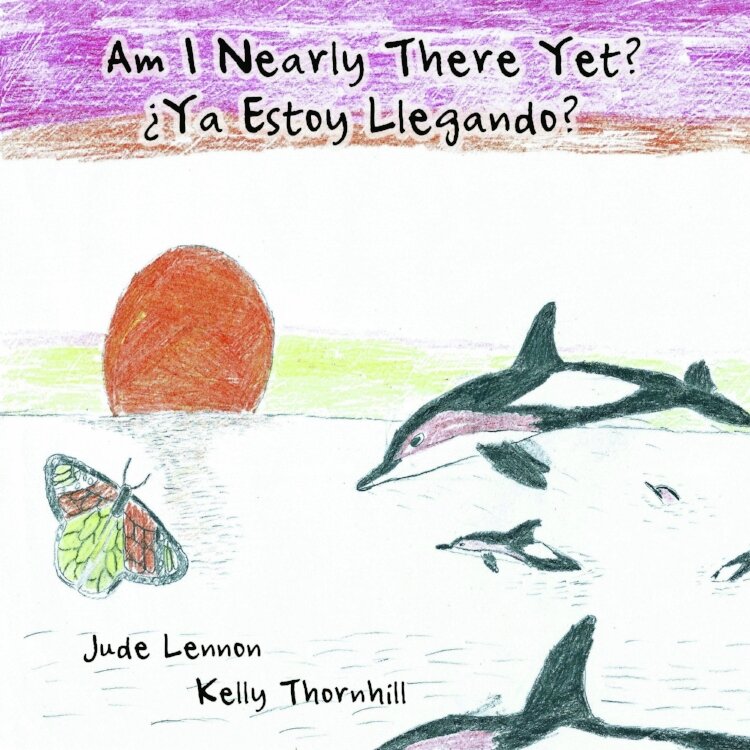
That book became ¿Ya Estoy Llegando? (Am I Nearly There Yet?). It follows Frida, a day-dreaming Monarch who falls asleep in butterfly school, misses the directions, and has to find her own way to Mexico before the festival starts. The children in my Spanish classes did the illustrations, and the front cover was drawn by Daniel Bassey, who was 13 at the time. We launched it at Sandbach Library surrounded by kids doing butterfly crafts – I’m still ridiculously proud of it.
It’s a gentle way to open up conversations about losing people we love, which is exactly what the festival is for. Every copy comes with a free mp3 of the story read in Spanish and English.
- Buy ¿Ya Estoy Llegando? on Amazon (affiliate link)
- Or get a signed copy with a personalised message in Spanish
Sharing the Day of the Dead with children
These are the resources I actually use in my classes – tried, tested, and (mostly) not too messy.
Make it
- Sugar skull biscuits – the BBC has a nice simple sugar skull biscuit recipe that works well with younger children
- Pan de muerto – The World on a Plate has a kid-friendly pan de muerto recipe to download
- Crafts – there are loads out there, but Growing Up Bilingual and Crafts on Sea are two of my favourites. Papel picado is a brilliant one – all you need is tissue paper and scissors
Watch it
- Coco – aspiring musician Miguel ends up in the Land of the Dead. Still a winner in our house!!
- The Book of Life – Manolo is torn between his family’s expectations and following his heart, and has to travel through three magical worlds to sort it out
- A short animated film about the Day of the Dead on YouTube – perfect for a lesson starter
- The Monarch butterfly migration – a stunning short video narrated by Meryl Streep
Say it
A few phrases to try while you’re crafting: ¡Feliz Día de Muertos! (Happy Day of the Dead!), vamos a poner la ofrenda (let’s set up the altar) and me acuerdo de… (I remember…) – that last one is lovely for children talking about someone they miss.
If you home educate, this makes a brilliant cross-curricular topic – Spanish, history, art, science (those butterflies!) and cooking all in one. It’s one of the themes we cover in Spanish Explorers, my live online classes for home-educated children.
If you go to Mexico for the Day of the Dead
Confession time again – this is the one I haven’t done yet. I’ve read about it, taught it and written about it… but I’ve never stood in a Mexican cemetery at midnight on 1st November. So this isn’t a “when I was there” section. It’s my wish list – the places I’d head for first.
- Oaxaca – probably the most famous place to experience it, with comparsas (street processions in costume and masks) and families keeping vigil in the cemeteries through the night
- Pátzcuaro and the island of Janitzio, Michoacán – known for candlelit boats crossing the lake and an all-night vigil on the island
- San Andrés Mixquic, Mexico City – a village on the edge of the capital famous for its candlelit cemetery
- Mexico City’s big parade – which, funnily enough, only started in 2016. The opening scene of the James Bond film Spectre showed a huge Day of the Dead parade that didn’t actually exist. Tourists turned up expecting one… so the city made one!!
- The Monarch Butterfly Biosphere Reserve, Michoacán – sanctuaries like El Rosario and Sierra Chincua, where you can stand among millions of butterflies. They arrive around the festival, but the best viewing tends to be from December to February
Wherever you go, the golden rule is respect. These are families remembering people they’ve lost. You’re usually very welcome to watch – but ask before taking photos of anyone’s altar or grave, and don’t treat it like a show.
And the food… pan de muerto by the slice, tamales, mole, cups of thick hot chocolate. I’m going one day. I’ve decided!!
Closer to home
You don’t have to fly to Mexico to see it. Day of the Dead celebrations have spread to the UK too – there have been parades and events in London, Birmingham, Manchester and Liverpool, with people dressing up as Catrinas and taking to the streets. It’s changed a bit on the way over (more face paint, fewer family altars), but it’s a fun way in.
Spain, by the way, doesn’t traditionally celebrate Día de Muertos at all. It has Todos los Santos (All Saints’ Day) on 1st November – quieter, with families cleaning graves, leaving flowers, and eating huesos de santo, little marzipan “saints’ bones”. Our Málaga immersion trip falls right around it, and I’ve written more about how Spain marks the date in Halloween vs Día de Muertos.
And here in Wales we’ve got Calan Gaeaf on 1st November – a night when spirits were said to roam – so the idea of the dead coming close at this time of year is closer to home than you might think.
So over to you – would you build an ofrenda with your children this year? And who’d be the first photo on it? Tell me in the comments – I’d love to know!!
