A parent messaged me a few weeks ago with a question I’ve heard dozens of times over twelve years of teaching Spanish.
Her daughter was ten. She’d been learning Spanish for three years — apps, some online lessons, a workbook. She clearly understood a lot. But she wouldn’t speak. Froze when anyone actually addressed her in Spanish. And her mum had no idea whether to put her in a beginners’ class (which felt wrong, because she wasn’t a beginner) or an intermediate class (which felt scary, because she wasn’t confident enough for that either).
This is exactly the problem with choosing a Spanish class by age or level alone. It doesn’t tell you nearly enough.
What that girl needed wasn’t a harder class or an easier class. She needed somewhere she felt safe enough to have a go — with a teacher who understood the gap between knowing Spanish and feeling confident using it, and a group of children who were in a similar position.
If you’re home educating and trying to work out which Spanish course is right for your child, here’s how I’d approach it.
Forget the Age Label — Start With What They Can Actually Do
The most common mistake I see is parents assuming “they’ve done Spanish for X years” tells you enough. It really doesn’t.
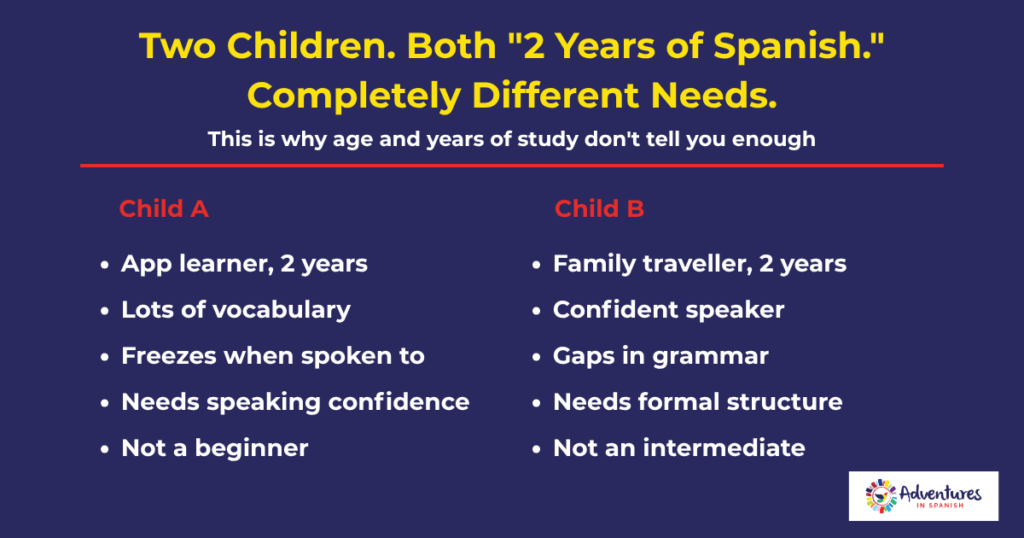
Think about two 11-year-olds.
Child A has been using a Spanish app for two years. They know lots of individual words, can recognise basic vocabulary, and can translate sentences reasonably well — but freeze completely when somebody actually speaks to them in real Spanish at normal speed.
Child B has travelled regularly to Spain with their family. They can chat confidently about what they like doing, order food, ask questions. But they’ve never formally learned how to form the past tense and their grammar is full of gaps.
Both have “two years of Spanish.” They need completely different things.
So rather than starting with age, ask what your child can actually do right now. Can they understand simple spoken Spanish without translating everything in their head? Can they introduce themselves and talk about their interests? Can they form sentences independently — or are they working word by word? Are they confident speaking, or do they avoid it?
Those questions tell you far more than a birth year.
If you’re not sure where your child sits, our free Spanish colours activity is a gentle, low-pressure way to see how they respond to Spanish — ten minutes, no pressure, and it tells you more than any level test.
Confidence Is Not the Same as Ability — and Both Matter
This is the thing I come back to most often.
A child can know Spanish without feeling confident enough to use it. They might understand the teacher perfectly well but never volunteer an answer. They might know the vocabulary but worry so much about getting the pronunciation wrong that they say nothing at all. I’ve taught children who’d been corrected so often — at school, in classes, by well-meaning parents — that they’d quietly learned to keep quiet rather than risk getting something wrong.
For a home-educated child, this matters especially. One of the great advantages of home education is the freedom to learn differently — to not have to perform in front of thirty classmates, to move at your own pace, to not have Spanish become the subject where mistakes feel dangerous.
When I first moved to South America in my twenties, I made plenty of ridiculous errors. I once confidently told an Argentine family I was embarazada (pregnant) when I meant to say I was avergonzada (embarrassed) — which, having said the first thing, I quickly became. The family were very kind about it. You have to be willing to sound ridiculous occasionally. That willingness is one of the most valuable things we can build in a language learner — and a good Spanish class should be building it, not eroding it.
Look for Real-World Spanish, Not Just Real Spanish
I’ve spent twenty years using Spanish outside a classroom — ordering food, raising children, running a business in Mendoza, arguing with shopkeepers, diving off the Colombian coast, chatting to neighbours in Argentina. Real Spanish is messy. People speak quickly. They use slang. They don’t use the textbook phrase you just learned. And you don’t always know the perfect word.
That’s exactly why children need to practise communicating rather than producing grammatically perfect sentences on a worksheet.
For home-educated children, this is one of the real opportunities Spanish offers. It doesn’t have to be a separate subject — it can run through everything else you’re already doing. Learning about Argentina? Cook empanadas and name the ingredients. Studying Andalucía? Listen to flamenco and look up what the lyrics mean. Planning a trip to Spain? Research it in Spanish. Learn about the Andes, the history of the Aztecs, what children in Colombia eat for breakfast — and suddenly Spanish isn’t just “Spanish.” It’s geography, history, culture, food and real communication all at once.
The best Spanish classes for home-educated children reflect this. Not endless verb conjugation, but language that goes somewhere.
If your child is in KS2 and just starting out, our First Steps course is built around exactly this — real Spanish from day one, in a small online group with other home-educated children, no previous experience needed.
Ask Where the Course Is Taking Them
Fun matters. But I’d also ask: what will my child actually be able to do after six months? A year? Three years?
If your child is eventually hoping to take GCSE or iGCSE Spanish, you don’t want to spend years bouncing between disconnected activities with no sense of progression. You want a pathway — even if GCSE is five years away. The early years should be building the foundations that make later Spanish easier: listening confidence, pronunciation, vocabulary, sentence-building, and an instinctive feel for how the language works. Then, as they get older, the more formal elements can build on that foundation rather than fighting against years of patchy habits.
The best Spanish course for a home-educated child is one that has somewhere for them to go next. If you’re thinking about GCSE specifically, this post on choosing between AQA, Edexcel and Cambridge iGCSE is worth reading before you commit to a course — because the board you choose should influence how you structure the years leading up to it.
How to Actually Choose
If you’re still looking at a list of Spanish classes thinking but which one would suit my child? — you’re not alone. This is the most common question I get.
My honest answer is: look at the whole child, not just their Spanish level.
Where are they now? What have they already done? What do they enjoy? What do they find difficult? How confident are they — not just at Spanish, but generally? What do you want Spanish to lead to? And — perhaps most importantly — will they actually look forward to it? Because the perfect Spanish course on paper isn’t the right course if your child dreads Tuesday afternoon.
Don’t be afraid to change your mind either. Children’s interests, confidence and learning needs change. A class that was perfect at eight might not be right at eleven. That’s not failure — that’s just learning.
The easiest way to find out whether Adventures in Spanish is the right fit is to try it — our free taster Spanish lesson is a real class, not a sales pitch. Your child comes along, meets the group, has a go, and you both get a proper sense of whether it works before committing to anything.
The Question Worth Starting With
After twelve years of teaching Spanish to home-educated children, and twenty years of using it in real life — in markets, on estancias, in diving schools, in the wine bodegas of Mendoza — I’ve never believed the goal was to produce children who fill in every blank correctly on a worksheet.
I want children who can walk into a shop in Spain and order something. Chat to another child. Understand a joke. Ask for directions. Make a friend. Travel somewhere and realise: actually, I can do this.
Those are the moments that make all those verbs and grammar rules worthwhile.
So if you’re trying to decide which Spanish course is right for your home-educated child, don’t start with “which level should they be in?” Start with: what do I want Spanish to make possible for them? Then find a course that helps them get there.
If you’d like to see how we’ve built our home education Spanish pathway — from complete beginners in our First Steps course right through to GCSE-level learners, in small online groups matched to ability rather than age — you can find out more about our Spanish classes for home educated children here. Not sure where to start? Try the free taster lesson first.
What’s the one thing you most want Spanish to do for your child? I’d love to hear it.