When it comes to travel around South America, it’s fair to say I know what I’m talking about. I spent five years travelling the length and breadth of the continent before settling in Argentina for fifteen years — Brazil aside, since they speak Portuguese there. I’ve also spent a good amount of time in Spain, most recently backpacking with my own children along the Costa Dorada.
Whether you’ve just started learning Spanish or have been speaking it your whole life, travelling to a Spanish-speaking country is one of the most powerful ways to develop your language skills. Not because of what you’ll study there, but because of what you’ll need to say — in real situations, with real people, where the language actually matters.
Here are my eight picks, with a personal note on each one.
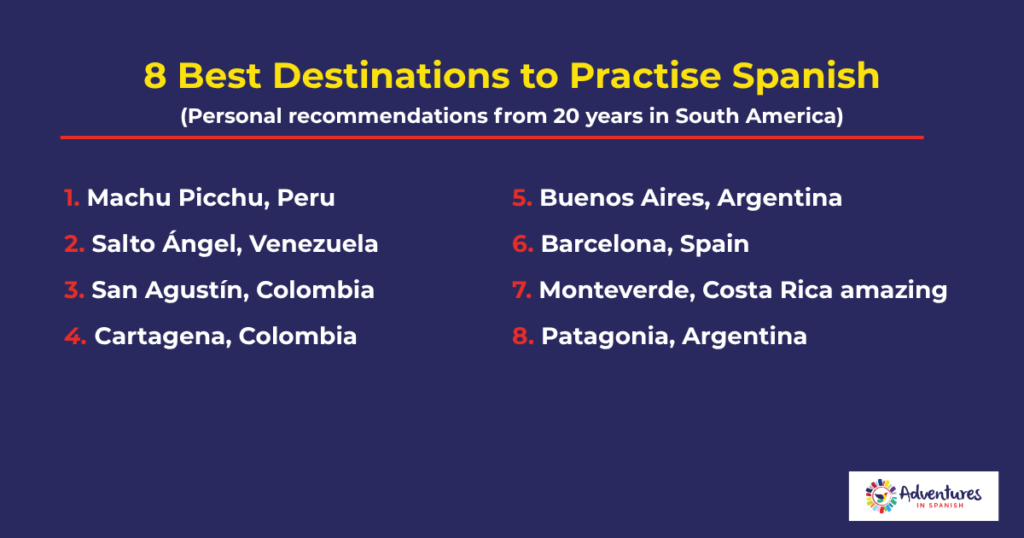
1. Machu Picchu, Peru
A visit to the lost Inca city is usually high on most people’s bucket lists, and rightly so. I visited in 2004 — standing at 2,430 metres above sea level, it’s one of those places that genuinely earns the word “breathtaking.” Around 84% of Peru’s population speak Spanish (Quechua and Aymara are the most widely spoken indigenous languages alongside it), which gives you roughly 25 million Spanish speakers to practise with. The combination of incredible scenery, rich history, and a genuine need to communicate in Spanish makes Peru one of the best all-round immersion destinations on this list.

2. Salto Ángel, Venezuela
Angel Falls is the world’s tallest uninterrupted waterfall — 979 metres high, with a plunge of 807 metres — nestled deep inside Canaima National Park in the Venezuelan state of Bolívar. I visited in 2003. We flew a small plane into the village of Canaima from Puerto Ordaz, then took a river trip to reach the falls trail. It remains one of the most extraordinary things I’ve ever seen.
Venezuela has around 32 million Spanish speakers, and the accent is clear and relatively easy to follow — good news for anyone who finds some of the faster regional accents challenging. The current situation means I’m not suggesting Venezuela as a travel destination right now, but it earns its place on this list for the language experience alone.

3. San Agustín, Colombia
Around 400km southwest of Bogotá, sheltered in a valley by the Magdalena river, San Agustín’s archaeological park is home to ancient tombs, burial sites, and over 500 stone figures of varying sizes depicting people, animals, and creatures significant to this mysterious civilisation. It’s the largest group of pre-Columbian religious monuments in South America, and it’s genuinely unlike anywhere else I’ve visited.
By the time I arrived in San Agustín I’d already been in Colombia for eight months — most of it scuba diving on the Caribbean coast near Cartagena — so I was ready for some inland adventure. An extraordinary 99.5% of the Colombian population speak Spanish, and the accent is widely considered one of the clearest and most accessible for learners.
4. Cartagena, Colombia
If San Agustín is the inland adventure, Cartagena is the reward. A stunning city on Colombia’s Caribbean coast with excellent beaches, a historic walled old town that’s entirely walkable, and colonial architecture that genuinely stops you mid-stride. I spent eight months based just up the coast in Taganga, diving most days and using Spanish for everything else — shopping, eating, navigating, making friends. It was one of the most naturally immersive periods of my language life.
Cartagena is warm, beautiful, and full of people who’ll happily chat — a genuinely great place to put your Spanish to work in relaxed, everyday situations.
5. Buenos Aires, Argentina
Home of tango, Maradona, and Eva Perón — and my home for fifteen years. Buenos Aires is an extraordinary city to visit and one of the best places in the world to hear Spanish in all its variety. If you want to experience the porteño accent (the distinctive eyyyyeee sound that replaces the double-l and y), hear lunfardo spoken naturally in conversation, and eat some of the best steak of your life, this is the place.
With 15 million people in Greater Buenos Aires alone, you’ll never be short of people to practise with — and Argentines are, in my experience, both patient with learners and genuinely interested in where you’re from. I’ve written more about the Buenos Aires accent and lunfardo in our guide to Spanish-speaking countries if you want to go deeper.
6. Barcelona, Spain
Barcelona has everything — beach, mountains, incredible food, and a city center that rewards aimless wandering. Everyone speaks Castilian Spanish in Barcelona, though many people are bilingual in Catalan and may default to it in everyday conversation. Don’t let that put you off — with a city population of over 1.6 million, you’ll find plenty of opportunities to practise your Spanish, and the Catalan-Spanish bilingualism is interesting in itself.
My most recent trip was with my daughter, who took part in an Argentine field hockey camp while I visited the language school we’ve partnered with to run our immersion trips. Seeing Barcelona through two completely different lenses in the same week — a hockey pitch on one side, a language school on the other — reminded me why it’s such a remarkable city. There’s always more than one reason to be there.
If you’re considering Barcelona as a destination for structured Spanish immersion, our Málaga immersion trip offers something similar with the language learning built in from day one — and a September Barcelona trip is on the horizon too.
7. Monteverde, Costa Rica
Monteverde sits in the centre of Costa Rica and is renowned for its cloud forests, waterfalls, and extraordinary biodiversity — thousands of plant species, hundreds of birds, over 100 types of mammals. Costa Rica is one of the most politically stable and family-friendly countries in Latin America, which makes it a popular first destination for families travelling with children.
The Spanish here is clear and unhurried — one of the easier accents to follow — and the ecotourism infrastructure means you’ll be using language in genuinely practical, varied situations: guided walks, local markets, accommodation where English isn’t always assumed. Pura vida is more than a tourist phrase; you’ll hear it everywhere, and it tells you something real about how people approach daily life here.
8. Patagonia, Argentina
I’ve written about the Y Wladfa Welsh community in Patagonia elsewhere, but there is so much more to this extraordinary part of Argentina. The Perito Moreno Glacier, Ushuaia and Tierra del Fuego, the Andean Lake District of Bariloche, Puerto Madryn — Patagonia contains some of the most dramatic scenery on earth, and it does it quietly, without the crowds you’d find at more famous destinations.
Argentines are a welcoming, curious bunch — you’ll often find them sharing mate (traditional Argentine tea drunk through a metal straw from a wooden gourd) or preparing an asado, and genuinely happy to talk, teach, and include you. For Spanish practice in a context that feels like a real conversation rather than a transaction, Argentina remains my favourite country on this list.
Have you visited any of these destinations? Which is your favourite — and what would you add to the list? Let me know in the comments.
If reading this has made you want to actually use your Spanish somewhere — not just study it — our Spanish Immersion Trip to Málaga is designed exactly for this: a week in a real Spanish city, real conversations, real cultural moments, without needing a long-haul flight to make it happen.
And if you’d like to build your Spanish confidence before your next trip, our adult Spanish classes run throughout the year — online and in North Wales — with small groups and real conversation practice from day one.