When I was home educating my own daughters in Argentina, “free Spanish resources” wasn’t really a concept that existed in any useful form. You had textbooks, you had dictionaries, and you had the world outside the front door.
The world outside the front door was, admittedly, quite effective.
Back in the UK, the options have exploded — and the challenge now isn’t finding free Spanish resources for children, it’s working out which ones are actually worth your time. There are hundreds of apps, websites, YouTube channels and printable packs out there, and most of them sit somewhere between “fine” and “forgotten after a week.”
So here’s my honest list — not everything that exists, but the ten I’ve actually used, recommended to families, or watched work in practice. Some of these I used with my own children. Some I recommend weekly to the home educating families we work with at Adventures in Spanish. All of them are genuinely free.
1. Duolingo
The one everyone’s heard of — and for good reason. Duolingo is genuinely good for building and maintaining vocabulary habits, particularly for children who respond well to the game-like streak mechanic. It’s not a complete language programme on its own (the speaking practice is limited and the sentences can be oddly abstract), but as a daily 10-minute supplement to structured learning it’s hard to beat for consistency.
Best for: children aged 8+ who need a daily habit Works best alongside: a structured weekly lesson rather than as a standalone programme
2. BBC Bitesize Spanish
BBC Bitesize is built around the UK curriculum, which makes it particularly useful for home educated children working toward KS3 or GCSE Spanish. The interactive lessons, videos, and quizzes are clear and well-structured, and the fact that it’s curriculum-aligned means it fills gaps rather than teaching in a vacuum.
Best for: KS3 and GCSE preparation Worth knowing: the content goes up to GCSE level, so it grows with your child
3. Memrise
I recommend Memrise over Duolingo for slightly older children (10+) who are ready for something more vocabulary-focused and less game-y. The spaced repetition system is genuinely effective for retention — it shows you words at the optimal moment for memory consolidation rather than just cycling through them randomly. The Spanish courses built into Memrise are solid, and you can also find user-created courses specifically designed for GCSE Spanish topics.
Best for: children aged 10+ building GCSE vocabulary Pro tip: search for “GCSE Spanish [topic]” in Memrise and you’ll find ready-made topic-specific decks
4. Twinkl
Twinkl is a teacher’s resource site with a genuinely substantial free Spanish section — printable worksheets, flashcards, games, and activity packs covering vocabulary topics, basic grammar, and cultural content. The quality varies, but the best Twinkl packs are excellent for hands-on, offline learning — particularly useful for younger children or families who want something away from a screen.
Best for: children aged 5-11, offline learning, parents who prefer printable resources Free access: Twinkl has a free tier — you don’t need a subscription for the basics
5. YouTube: Spanish for Kids Channels
YouTube has a surprisingly strong collection of Spanish content for children — the challenge is knowing where to look. Three channels worth bookmarking:
- Basho & Friends — songs and simple Spanish for younger children (4-8), genuinely fun rather than worthy
- Butterfly Spanish — clear, friendly grammar and vocabulary explanations for older children and parents supporting their learning
- Spanish with Paul (beginner series) — particularly good for children aged 10+ who want to understand the why behind the language, not just memorise phrases
Best for: all ages depending on the channel — start with Basho & Friends for under-8s, Butterfly Spanish for 9+
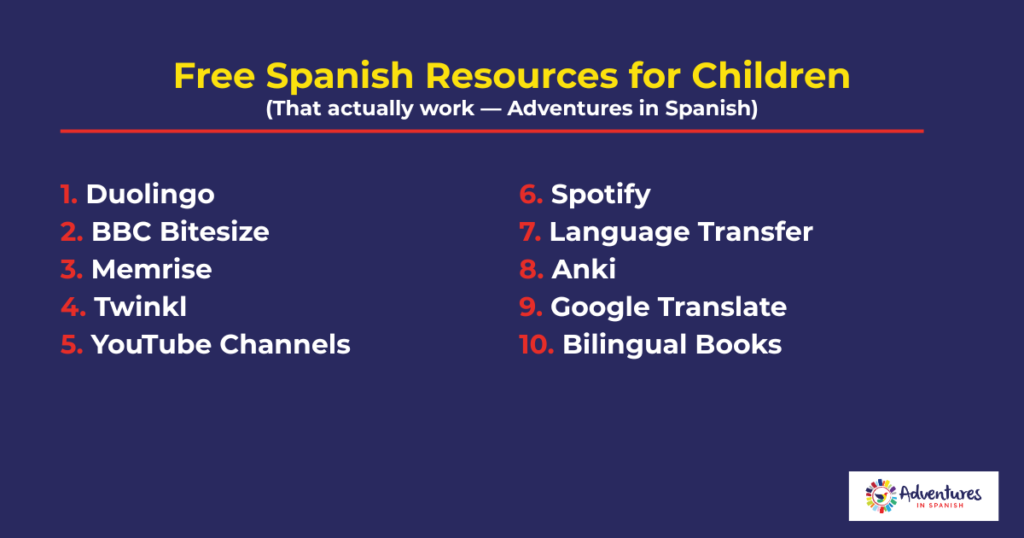
6. Spotify: Spanish Music and Podcasts
This one gets underused by home educating families, and I think it’s because it doesn’t feel like “proper learning.” But passive listening — Spanish music on in the background during lunch, a Spanish podcast on a car journey — builds ear-training faster than almost anything else, particularly for children who are also doing structured lessons.
For younger children: search “canciones infantiles en español” (children’s songs in Spanish) — there are hundreds of playlists. For older children: Notes in Spanish (beginner series) is excellent. For teenagers: any music by artists they already like, searched in Spanish.
Best for: all ages — adapts to whatever your child is already into How to use it: background listening counts. It doesn’t have to be focused study.
7. Language Transfer: Complete Spanish
Language Transfer is the best free Spanish resource most people have never heard of. It’s an audio course — no app, no gamification, just a teacher walking you through Spanish in a way that builds genuine understanding rather than memorisation. It’s structured around the idea that Spanish and English share thousands of words, and by the end of the course a learner has a surprisingly solid grammatical framework to hang vocabulary on.
It’s not designed for young children — I’d say 12+ — but for teenagers or parents who want to understand Spanish well enough to support their child’s learning, it’s remarkable for something that costs nothing.
Best for: teenagers and parents, complete beginners Find it at: languagetransfer.org (free, no sign-up required)
8. Anki (Flashcard App)
Anki is a free flashcard app using the same spaced repetition principle as Memrise but more customisable — you can build your own decks or download pre-made ones. It’s less pretty than Memrise and has a steeper setup curve, but for GCSE students who want to build topic-specific vocabulary efficiently, it’s one of the most effective tools available.
Best for: GCSE students aged 14+, self-directed learners Free decks: search “GCSE Spanish AQA” or “GCSE Spanish Edexcel” in the Anki shared deck library
9. Google Translate (Used Properly)
Google Translate gets a bad reputation in language learning circles because it’s often used as a shortcut — paste the English in, copy the Spanish out, done. Used differently, it’s genuinely useful: children can type a Spanish sentence they’ve written themselves and use it to check accuracy, or listen to the audio pronunciation of new words. The camera function (point your phone at text and it translates in real time) is also a surprisingly engaging way to bring Spanish into everyday life — menus, labels, signs on trips.
Best for: checking work, pronunciation practice, making Spanish feel real in everyday settings How to use it well: as a checking tool after attempting something, not a replacement for attempting it
10. Adventures in Spanish Own Bilingual Books
I’ve written two bilingual children’s books — Fernando Baila el Tango and Ya Estoy Llegando — both of which are available on Amazon and used by families across our programmes. They’re not free, but I’d be leaving them off this list dishonestly if I didn’t mention them, so consider this an honourable mention rather than a true free resource.
What is free: your local library. Most UK libraries have a Spanish children’s section, and the combination of familiar English story structures with Spanish text is one of the most underrated tools for building reading confidence in a second language. Ask your librarian — they can often request books from other branches if the selection is thin.
Best for: younger children aged 4-10, reading alongside a parent
Best Spanish Apps for Children (Updated 2026)
Apps deserve their own section because they work differently from websites and YouTube channels — they’re designed for short, regular sessions on a phone or tablet, which makes them particularly useful for building daily habits rather than sitting down for a “proper lesson.”
Here’s what’s actually worth downloading right now, as of 2026:
Duolingo — already covered above as resource #1, but worth reiterating here: it’s the best habit-building app available, particularly for children aged 8+. The streak mechanic genuinely works for maintaining consistency, which is often the hardest part of home language learning.
Memrise — also already covered above, but specifically worth downloading as an app because the mobile version is slightly better than the desktop for quick vocabulary sessions. Particularly useful for GCSE topic vocab on the go.
Lingopie — the one I’d most recommend that most families haven’t heard of. Lingopie lets children watch real Spanish TV shows and films with interactive dual subtitles — click any word and it defines it, adds it to a flashcard deck, and quizzes you on it later. It’s not free (there’s a subscription), but the free trial is generous and it genuinely bridges the gap between “watching Spanish TV” and “actually learning from it.” Worth trying before you commit.
Gus on the Go — specifically for younger children (4-8). It’s a simple, cheerful app that introduces vocabulary through short games and a friendly animated character, and it’s still actively maintained unlike several of the older apps that used to dominate this category. The first few lessons are free.
Drops — vocabulary-focused, beautifully designed, works in short five-minute bursts. Better suited to children aged 10+ who find Duolingo too game-y but still want something phone-friendly. The free version gives you five minutes per day, which is honestly enough for a supplement to other learning.
One honest note on apps generally: no app, however well-designed, replaces structured learning with a real teacher. What apps do well is habit, vocabulary maintenance, and keeping Spanish present in a child’s daily life between lessons. What they don’t do well is speaking practice, genuine comprehension in real contexts, or the kind of confidence-building that comes from actual conversation. Use them as the daily habit layer — not the whole programme.
Best Spanish TV Shows and YouTube Channels for Children

Passive listening is one of the most underrated tools in language learning — and Spanish TV and YouTube is one of the easiest ways to build it into everyday life without it feeling like study. The key is choosing the right content for your child’s age and level.
For younger children (4-8)
Pocoyo (YouTube) — a simple, dialogue-light Spanish animated series that works beautifully for very young children precisely because the language is slow, clear and repetitive. Search “Pocoyo en español” on YouTube — most episodes are free. The limited vocabulary per episode means children actually pick up and retain words rather than being overwhelmed.
Cleo y Cuquín (YouTube) — based on the classic Spanish comic La Familia Telerín, this is a warm, gentle series about a young girl and her baby brother. The Spanish is clear and natural, the episodes are short, and the cultural references are genuinely Spanish rather than dubbed-over American content.
Basho & Friends (YouTube) — songs and simple Spanish vocabulary, high energy, genuinely fun rather than worthy. Works particularly well for children who respond to music — the songs are catchy enough that children end up singing them (and therefore practising their Spanish) without realising they’re doing it.
For children aged 8-12
Salsa (BBC/YouTube) — an award-winning Spanish language series originally made for UK school children aged 5-9, which means it’s specifically designed for learners rather than native speakers. The language is scaffolded properly, the pace is accessible, and it covers real communicative situations rather than abstract vocabulary lists. Search “Salsa BBC Spanish” on YouTube.
Los Lunnis (YouTube) — a classic Spanish children’s show featuring puppet characters that teaches vocabulary, history, science and culture. More culturally authentic than dubbed content, and good for children who are ready for something slightly less “designed for learners” and more “actually Spanish.”
For teenagers
At secondary age, the best approach is usually to find Spanish versions of content your child already enjoys in English — the motivation to understand something they’re actually interested in is a more powerful learning driver than any specifically educational programme.
Practical starting points: switch Netflix subtitles to Spanish on shows they already watch (or switch the audio track on animated content where dubbing tends to be high quality), search for Spanish YouTube creators in whatever interests them (gaming, cooking, sport), or try Extra en Español — a deliberately simple Spanish drama series made for language learners that’s now available free on YouTube and works well for ages 12+ who want something more grown-up than children’s cartoons.
How to make TV time count
Watching Spanish TV passively is useful — it builds ear-training and vocabulary recognition even without conscious effort. But you can make it work harder with a few small additions:
- Pause on a word they don’t recognise and look it up together — one word per episode is enough
- After an episode, ask one question in Spanish about what happened (“¿Qué pasó?” — what happened?)
- Print a simple colouring sheet or activity related to the show’s characters and name things in Spanish while you do it (this works particularly well with Pocoyo for younger children)
None of this needs to be formal. The point is to give the passive watching one small active moment that helps it stick.
How to Get the Most From Free Resources
Here’s the thing nobody tells you about free resources: the problem was never finding them. The problem is that without structure, most children use them inconsistently, plateauing after a few weeks when the novelty wears off — and then stopping entirely.
Every resource on this list works better when it’s part of a regular routine rather than something picked up when you happen to remember it. Ten minutes of Duolingo every morning before breakfast beats an hour on a Saturday once a fortnight, every time. A Spanish song on during lunch twice a week beats an intensive YouTube session on a rainy afternoon that doesn’t happen again for a month.
The families whose children make the most visible progress tend to have two things in place: a free resource for daily habit-building (Duolingo, Spotify, Memrise), and a structured weekly lesson that gives everything else somewhere to go.
If you’re at the point where you’d like that structured element — a proper weekly session with an experienced tutor, built around the Spanish Explorers framework and adapted to your child’s level — our Spanish for Home Educators courses are designed exactly for this. Small groups, live online, with resources and Google Classroom access between sessions.
And if your child is starting out from scratch, our free Spanish taster session is the easiest way to see whether it’s the right fit — no commitment, just a proper lesson to try it out.
Which of these ten have you already tried? And is there one I’ve missed that your family swears by? Let me know in the comments — I’m always adding to this list.