Here’s a question I get asked more than almost any other: what’s the difference between ¿cómo estás? and ¿cómo eres?
On the surface they look almost identical. Same question word (cómo — how/what), same person (you), completely different meaning. And if you mix them up, you’re not just making a grammar mistake — you’re asking a completely different question from the one you intended.
So let’s clear this up once and for all.
The Root of the Confusion: Two Verbs for “To Be”
The reason this trips people up is that Spanish has two verbs where English has one. In English, everything is “to be” — I am, you are, he is. In Spanish, that one verb splits into two:
- Estar — used for temporary states, feelings, and locations
- Ser — used for permanent characteristics, identity, and description
Once you understand that distinction, ¿cómo estás? and ¿cómo eres? make complete sense.
Estar: How You Are Right Now
Estar covers things that change — how you’re feeling today, where something is located, what’s happening in the moment.
Conjugated in the present tense: estoy — estás — está — estamos — estáis — están
So estás means “you are” in the temporary sense. Put cómo in front of it:
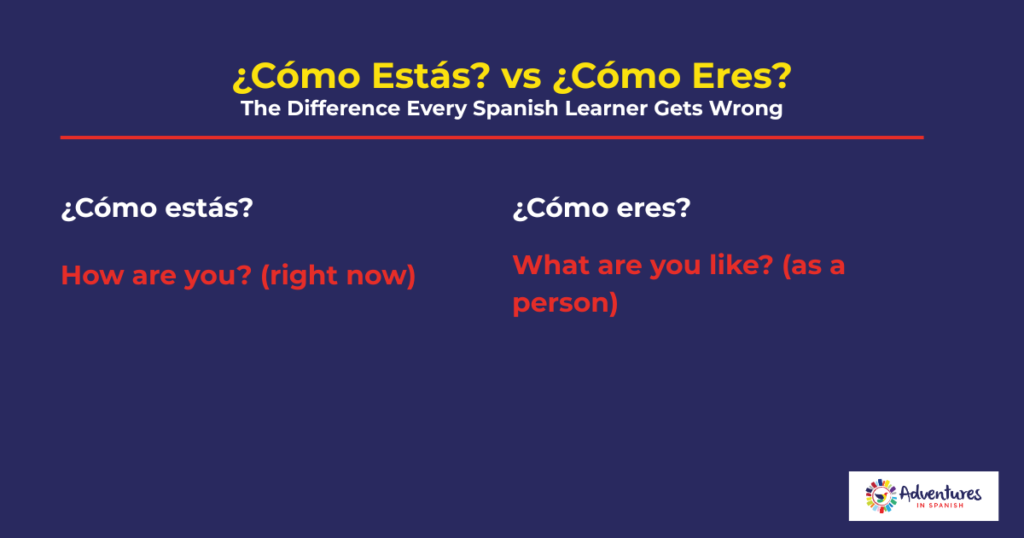
¿Cómo estás? = How are you? (right now, today, in this moment)
The natural reply: Estoy bien, gracias — I’m well, thank you. Or estoy cansada (I’m tired), estoy emocionada (I’m excited). All temporary, all changeable.
Ser: What You’re Actually Like
Ser covers the permanent stuff — your identity, your nationality, your profession, your personality, your physical description. Things that don’t change day to day.
Conjugated in the present tense: soy — eres — es — somos — sois — son
So eres also means “you are” — but in the permanent sense. Put cómo in front of it:
¿Cómo eres? = What are you like? (as a person, your character, your appearance)
This is a much deeper question. If someone asks you ¿cómo eres? they want to know about your personality and your physical description — soy alegre y paciente (I’m cheerful and patient), soy alta y morena (I’m tall and dark-haired). Not how your Tuesday is going.
Since ser crops up in so many everyday situations, it’s worth getting comfortable with it beyond just describing personality. A great place to practise is how to say where you’re from in Spanish — it uses ser in a real conversational context and gives you something immediately useful to say.
Side by Side
| ¿Cómo estás? | ¿Cómo eres? | |
|---|---|---|
| Verb | Estar | Ser |
| Meaning | How are you? | What are you like? |
| Refers to | Feelings/state right now | Personality/appearance |
| Example reply | Estoy bien, gracias | Soy simpática y trabajadora |
A Quick Way to Remember It
Estar = temporary = how you feel today Ser = permanent = who you are always
So if someone asks ¿cómo estás? they’re checking in. If they ask ¿cómo eres? they want to actually get to know you — which, fair warning, might need a slightly longer answer than bien, gracias.
Practice Your Pronunciation
I put together a short YouTube lesson to help you practice saying both questions correctly — because knowing the difference is one thing, saying it with confidence is another. Watch it here.
And if you’d like to get to the stage where grammar questions like this stop tripping you up entirely — where ser and estar just feel instinctive rather than something you have to think through — our adult Spanish classes run throughout the year in North Wales and online. Small groups, real conversation from day one, tutors who’ve actually lived in Spanish-speaking countries.