



There’s a moment I watch for on every Málaga trip.
It usually happens on day two or three — not in the classroom, but somewhere outside it. A child is at the panadería counter, pointing at something behind the glass, and without thinking they say “¿Cuánto cuesta?” — how much is it? — and wait for the answer. Not because they were told to. Because they needed to know. That’s the moment. The one where Spanish stops being a subject and starts being a tool.
I’ve been creating these moments for families for years now, first with student groups in Mendoza – Argentina, and now through our immersion trips to Málaga. And the pattern is always the same: it’s not the classroom hours that change things. It’s the moments in between.
Why Spain Works for Immersive Language Learning
Spain is an obvious choice for a UK family wanting immersive Spanish learning — two and a half hours on a plane, same time zone, and a genuinely Spanish-speaking daily life waiting on the other side of the airport doors. But proximity isn’t the only reason.
What makes Spain — and Málaga specifically — work for immersion is that it’s a real city going about its real business. The mercado (food market) isn’t there for tourists. The mercadillo (pop-up street market) isn’t performing Spanish for visiting learners. The conversations children have there are real, with real people who have somewhere to be and things to do. That’s the environment that produces the moment I described above — because in a real environment, you actually need the language.
This is what separates a genuine immersion experience from a Spanish-themed holiday. A holiday might put Spanish nearby. Immersion puts you inside it.
What Happens to a Child’s Spanish in a Week
The question I’m asked most often is: can one week really make a difference?
Honestly — not to fluency. I’ll always be straight about that. But fluency isn’t the only measure of what’s happening when a child does an immersion trip, and it’s not usually what parents are hoping for either.
What I see, consistently, across every trip we’ve run:
Confidence changes first. Children who’ve been learning Spanish for a year but rarely speaking it out loud discover, often for the first time, that they can actually hold a conversation. Not a perfect one. But a real one. That shift — from “I know some Spanish” to “I can use Spanish” — is significant, and it tends to be sticky in a way classroom learning alone isn’t.
Listening comprehension jumps. Being surrounded by real spoken Spanish at natural pace — in cafés, on the street, from the teachers, from local children — calibrates a learner’s ear faster than any recording. By day three, children are picking up words and phrases they weren’t consciously trying to learn.
Motivation transforms. This is the one parents comment on most when they get home. One parent from our 2023 Málaga trip put it simply: “The confidence boost from being immersed in the language and culture is worth every penny.” Another said it gave her son “so many learning opportunities” beyond what any lesson could provide.
That motivation — the realisation that Spanish is something real people use to connect, laugh, and live — is often what makes everything that comes next finally stick.

How We Structure the Days in Málaga
Immersion without structure can feel overwhelming, especially for younger children. The way we build our Málaga days is deliberate: enough structure to build confidence, enough real-world time to make it count.
Mornings start with lesson time — giving children the specific language they’ll need for what’s coming next, rather than abstract grammar. Then that language goes straight to work: ordering at the local panadería, navigating the mercado, asking questions in real situations where the answer actually matters.
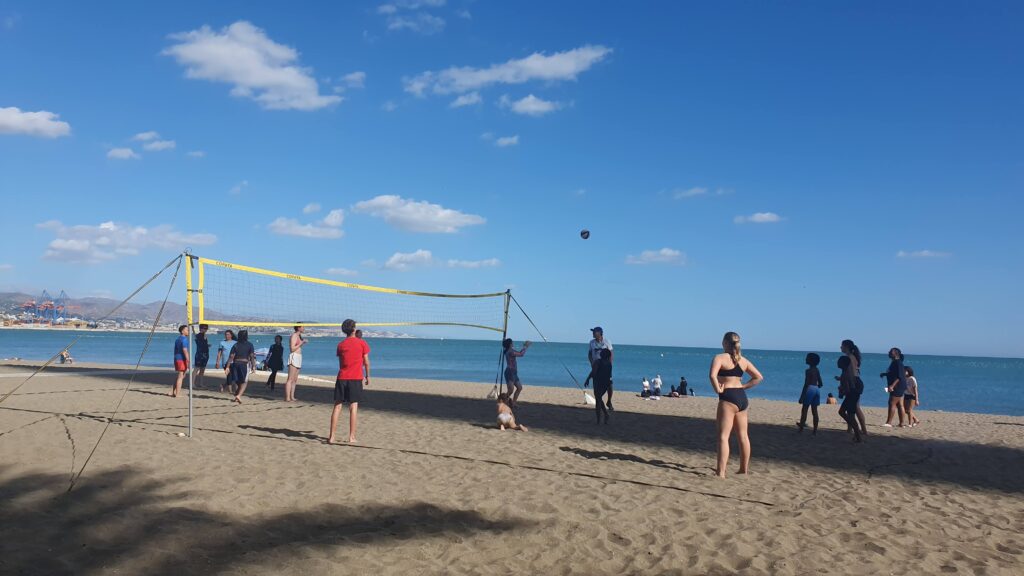
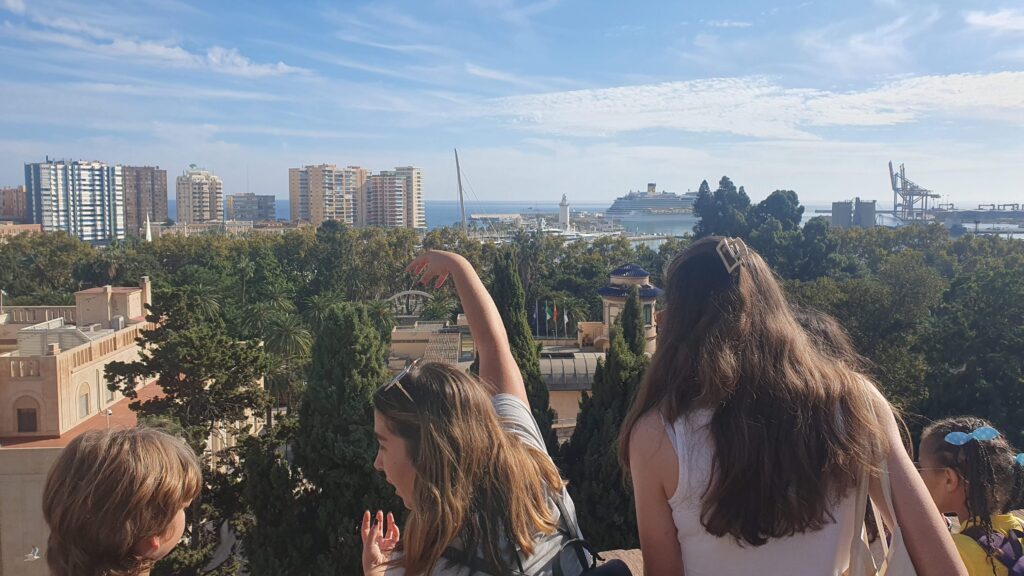
Afternoons move through cultural experiences that bring the language to life — the historic Alcazaba, a cooking class with a professional Spanish chef, the beach, the city. Evenings are quieter: helados (ice cream) and churros at a local café, conversations with new friends, the small moments that tend to be the ones children remember longest.
Groups are small — never more than 10 on the home stay — and activities are adapted so children at different levels can all build confidence at their own pace. As one child wrote after the 2023 trip: “I made lots of new friends and the lessons were very appropriate for my standard — not too hard, not too easy.”
That balance is the whole point. Not a full-on language school, not a holiday with some Spanish nearby — both at once.
Who Benefits Most From Immersive Language Learning in Spain
Immersive language learning works for all ages and levels, but in my experience it has the most dramatic impact on two groups specifically.
Children who’ve been learning Spanish for a year or two but haven’t yet spoken it in a real context. The trip becomes the place where everything they’ve already learned suddenly has somewhere to go. They hear words they recognise, manage real conversations, and come home with evidence that they can actually do this — which is worth more than any test result.
Home educated children and worldschooling families who already learn through real-world experience rather than traditional classroom methods. The immersion format fits naturally with how these families approach learning — and the flexibility of the home-ed calendar makes a week in October or spring genuinely possible in a way it often isn’t for schooled families.
You can read more about why Spanish immersion trips work particularly well for home educating families here, and about the journey that shaped how we approach immersion teaching here.
The Thing a Classroom Can’t Replicate
I learned the core lesson about immersive language learning not in Málaga but twenty years earlier, living with a family in Venezuela. Spanish didn’t slow down because I was still learning it. I had to listen harder, watch faces, pick meaning from context, and try again in the next conversation.
That experience — needing the language, in a real moment, with something genuinely at stake — is what makes immersion different from any amount of classroom time. It’s not that classrooms don’t work. It’s that immersion adds something a classroom structurally cannot: genuine need.
A week in Málaga won’t replicate living with a family in Venezuela for a year. But it can give a child a version of that genuine need — real enough to shift something, in a week that’s actually possible to take.
That’s what we’ve built the trips around. And it’s why, when parents ask me whether one week can really make a difference, my honest answer is: not to fluency — but to everything else that matters, yes.
Find out more about our Spanish Immersion Trips to Málaga →
And if your child is still building the Spanish foundations that make a trip like this land properly, our Spanish for Home Educators and GCSE Spanish courses are where most of our Málaga families start.

