Picture the scene.
You ask your child something in Spanish — something simple, something you know they understand — and they look at you, pause for a moment, and then reply in perfect English.
Or they say nothing at all.
Or, my personal favourite: “Mum, can you just say it in English?”
If this sounds familiar, you are absolutely not alone. I’ve seen it dozens of times over twelve years of teaching Spanish to children, and I saw it with my own daughters growing up bilingual in Argentina – especially when we moved back to the UK where everyone around us was suddenly speaking English. A child can understand far more Spanish than they’re willing to produce — and that gap between understanding and speaking can feel baffling, and occasionally quite maddening, for the parents watching it happen.
But here’s the thing: a child who understands Spanish but won’t speak it isn’t necessarily struggling with Spanish. Very often they have plenty of Spanish in their heads. What they don’t yet have is the confidence, the automaticity, and the regular opportunity to bring it out.
That is a very different problem — and one we can work with.
Understanding and Speaking Are Different Skills
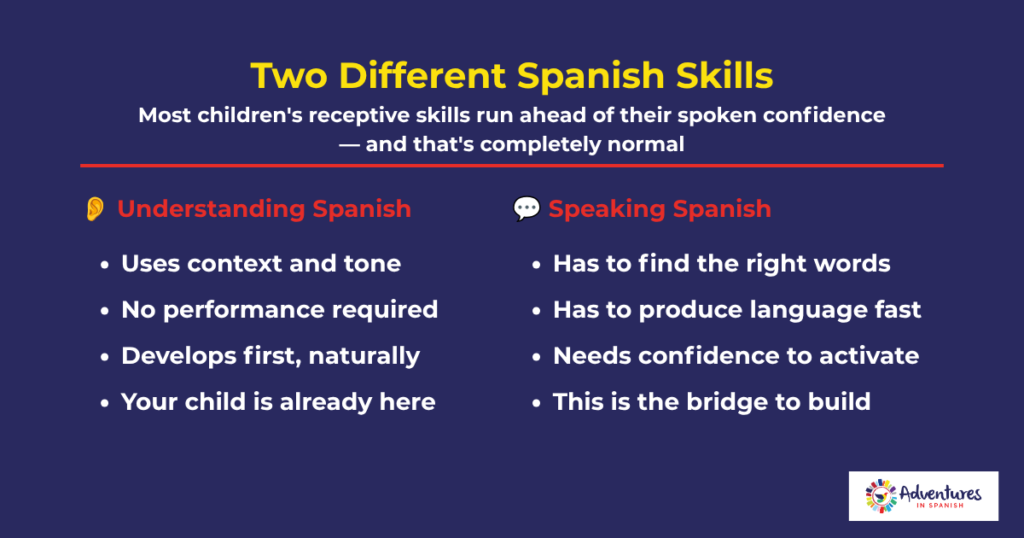
The first thing worth knowing is that receptive Spanish (understanding) and productive Spanish (speaking) are genuinely different skills — and children often develop them at very different rates.
When your child listens to Spanish, they can use context, tone of voice, familiar words and gestures to work out what’s happening. They don’t have to produce anything themselves. Speaking is much more demanding: they have to find the right words, put them in the right order, remember the grammar, pronounce everything reasonably well, and then actually open their mouth and say it — quickly, while someone waits.
It’s a bit like the difference between recognising someone you know in a crowd and having to give a speech about them on stage. One feels manageable. The other requires you to perform.
So if your child has had plenty of exposure to Spanish — through lessons, travel, family, or simply hearing it at home — but relatively few situations where they had to speak it, their receptive skills can quite naturally be running ahead of their spoken confidence. This is completely normal.
“But they know the words!”
Yes — and this is another important distinction.
Your child might know that comer means “to eat.” They might understand ¿Qué quieres comer? and even be able to tell you the answer if you give them some choices.
But knowing a word and being able to retrieve it instantly in the middle of a real conversation are not quite the same thing. A child can know hundreds of Spanish words and still freeze when someone asks ¿Qué hiciste el fin de semana?
They don’t need another vocabulary list. They need practice using what they already know — in real situations, with real people, where the language actually matters.
They May Be Worried About Getting It Wrong
This is a big one, and it gets bigger as children get older.
A six-year-old will quite happily invent a Spanish word and carry on with their day. A twelve-year-old may decide they’d rather say nothing than risk getting a verb ending wrong in front of someone. And I’ve definitely taught teenagers over the years who understood considerably more Spanish than they were prepared to admit — because admitting it meant being expected to use it.
For reluctant speakers, the fear isn’t usually “I don’t know Spanish.” It’s closer to “what if I try and it comes out wrong?” And when saying nothing feels safer than risking embarrassment, silence becomes the default.
So sometimes the right question isn’t “does my child know enough Spanish?” It’s “does my child feel safe enough to try?” That changes how we approach the problem entirely.
English Is Simply Easier
There’s also a perfectly logical reason your child may choose English over Spanish: English works.
It’s the language of their friends, their books, their games, their YouTube, their everyday life. When they want to say something complicated or exciting, English gets them there faster. If everyone around them understands English perfectly well, there may be very little genuine reason to push themselves into Spanish.
This isn’t laziness — it’s efficiency. And it’s why creating real reasons to communicate in Spanish is so much more powerful than simply telling a child they need to practise more.
How to Help a Reluctant Spanish Speaker
The answer isn’t more pressure. For a reluctant speaker, more pressure usually produces less Spanish. Instead, we want to create lots of small opportunities where speaking Spanish feels useful, achievable and — ideally — interesting.
Start With Tiny Wins
Don’t begin with “right, we’re only speaking Spanish from now on.” That can feel enormous and tends to produce resistance rather than results.
Instead, look for small moments in the day.
“¿Quieres agua o zumo?” (Do you want water or juice?) “¿Dónde están tus zapatos?” (Where are your shoes?) “¿Tienes hambre?” (Are you hungry?)
If your child answers in English, you don’t need to turn it into a correction exercise. Simply model the Spanish back — child says “I want juice,” you say “vale, quieres zumo” and carry on. The aim is to increase the amount of Spanish in the air around them, not to catch them out.
Give Them Language They Can Actually Use
One of the reasons I love teaching Spanish through real-life situations is that the language suddenly has a purpose beyond the lesson itself.
We’re not learning ten words for household objects. We’re practising how to order food in a café in Málaga, ask for directions in Buenos Aires, or chat to another child at a Spanish market. That’s a completely different experience — and it’s why children who’ve done our Spanish immersion trips often come back speaking more confidently after one week than they have in a year of lessons. Not because the trip taught them more grammar, but because it gave them genuine reasons to communicate.
Children don’t necessarily need more Spanish lessons where they fill in gaps. They need opportunities to do things with Spanish.
Don’t Correct Every Mistake
If your child finally launches into a sentence in Spanish and you immediately stop them to correct every verb ending and pronunciation, there’s a good chance their next contribution will be “I don’t know” — or they’ll go back to English.
There is a time and place for accuracy. But when the goal is building speaking confidence, communication comes first.
If your child says “Ayer yo ir al parque,” you can respond naturally: “Ah, fuiste al parque — ¿con quién fuiste?” You’ve modelled the correct form without stopping the conversation. They hear it, they get another chance to use it, and the conversation keeps going.
Give Them Something Interesting to Talk About
Ask a twelve-year-old “¿qué hiciste hoy?” and you might get “nothing” — in any language.
Ask them about their favourite football team, a Minecraft build, a horse they’ve been riding, a recipe they want to try, or something they’re saving up to buy, and suddenly they have something they genuinely want to communicate. The more interesting the subject, the less noticeable the language feels. Spanish becomes the tool for having the conversation rather than the subject of the conversation. That’s exactly where we want it to be.
Find Other People to Speak Spanish With
This can make a significant difference, particularly for home educating families.
If Spanish only ever happens with Mum or Dad, children can slip back into English very easily — because English has always worked perfectly well at home. Having another person to speak Spanish with creates a different dynamic. It might be a tutor, a conversation group, children they meet while travelling, or a structured class where they know: this is my Spanish time.
For home educated children, a small group setting often works particularly well — there’s a social element that makes speaking feel more natural, and hearing other children have a go (and get things wrong, and carry on) is quietly reassuring in a way that one-to-one tuition sometimes isn’t. You can find out more about how we structure that in our Spanish classes for home educated children.
The Bigger Picture: Confidence Over Perfection
The most important thing I’ve learned from twelve years of teaching Spanish — and from twenty years of living, working and raising my daughters in South America — is that language isn’t primarily about knowing the right words.
It’s about being willing to have a go.
I’ve watched it happen in Mendoza, Argentina with student groups who arrived nervous and left three weeks later holding conversations they hadn’t believed themselves capable of. I watched it with my own daughters, who didn’t learn Spanish from lessons — they learned it because they needed it, every single day, to make friends and be understood and join in. And I see it now on our immersion trips, when a child who’s been reluctant all week suddenly orders their own helado (ice cream) at a beach café without being asked, turns around with the biggest grin, and realises they just did that.
That’s when Spanish stops being a subject and starts being a language. And it almost never happens through drilling vocabulary or correcting verb endings.
It happens through small successes. Real conversations. Genuine need. And the growing belief that mistakes are just part of how this works.
If your child currently understands Spanish but won’t speak it, please don’t assume you’ve failed — or that they aren’t capable of becoming a confident Spanish speaker. The receptive foundation they’ve already built is genuinely valuable. Now they need the bridge between “I understand Spanish” and “I can actually use it.”
And if you’re wondering how long that bridge typically takes to build, this post on realistic Spanish learning timelines for home educated children might be a useful next read.
Does any of this sound like your child right now? I’d love to hear what’s working — and what isn’t.