One of the questions I’m asked most often by home educating parents is some version of this: how long will it actually take? Sometimes it’s “how long before they can have a real conversation?” Sometimes it’s “how many years before they’re fluent?” And sometimes it’s a slightly worried “we’ve been learning for a while and they still can’t really speak it — are we doing something wrong?”
After more than twenty years of living, travelling, working and raising my family in South America — and more than twelve years teaching Spanish to children and adults — I can tell you that the honest answer is: it depends. But it also depends on different things from what most parents expect.
Because children don’t learn languages in a straight line. And learning Spanish isn’t really about ticking off a certain number of hours until suddenly, one morning, your child wakes up fluent. It’s about gradually building confidence, understanding, vocabulary, listening skills and the ability to communicate. And that looks different for every child.
How Quickly Can Children Learn Spanish Through Home Education?
One of the biggest advantages of home education Spanish is that you don’t have to treat Spanish as another subject that needs to be “completed.” Instead, you can allow it to become part of your child’s wider world.
A child might learn how to introduce themselves, ask for something to eat or say what they like within their first few weeks. After a few months, they might be able to talk about their family, hobbies, pets or what they did at the weekend. After a year of consistent learning, they may be able to hold a simple conversation, understand familiar questions and express their opinions.
But here’s the important bit: they don’t need to wait a year before they can speak Spanish. Speaking can — and should — start from the beginning.
That’s something I’ve always believed in my own teaching. When I first moved to South America in my twenties, I certainly didn’t sit down and wait until my Spanish was “good enough” before I started using it. I had to communicate. I had to make mistakes. I had to work things out from context. I had to listen to people speaking at normal speed when I understood perhaps one word in ten. And gradually, the pieces started fitting together.
That’s how real languages work. Which is also why I don’t think the most useful question is “how long does it take to learn Spanish?” A better question is: what do you want your child to be able to do in Spanish, and how often are they going to use it? Those two things make a huge difference.
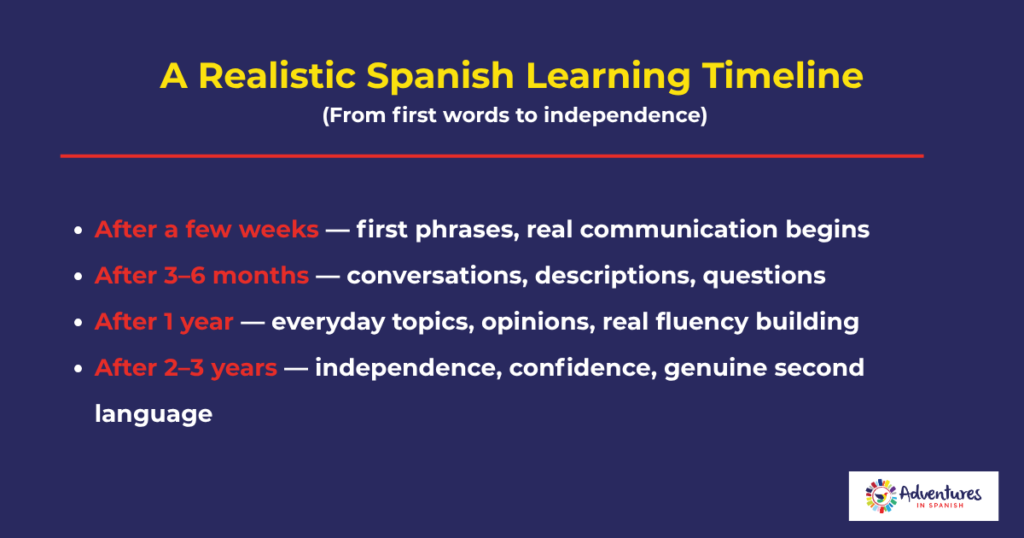
A Realistic Spanish Learning Timeline
Of course, parents still want some idea of what progress might look like. So here’s a rough guide.
After a few weeks, a complete beginner may be able to say hello and goodbye, introduce themselves, say their age, ask and answer simple questions, and use a small number of useful phrases independently. That might not sound like much — but your child has gone from knowing no Spanish to using Spanish to communicate. That’s the foundation everything else builds on.
After 3–6 months, with regular lessons and opportunities to practise, many children can begin to talk about their family and interests, describe people and places, talk about their daily routine, ask simple questions, and build short conversations rather than just producing individual sentences. This is often when children start to realise that Spanish isn’t simply something they learn — it’s something they can do.
After 1 year, a child who has been learning consistently might be able to manage a range of everyday conversations. They may still make mistakes — lots of them. But they can start communicating ideas rather than simply repeating memorised phrases. They might be able to tell you about their weekend, describe a holiday, talk about their hobbies, or explain what they think about something. That is a huge milestone.
After 2–3 years, with consistent exposure, regular speaking practice and increasingly challenging material, a child can develop much greater independence. They may be able to follow conversations more easily, understand different tenses, give opinions, explain reasons and communicate with Spanish speakers without needing everything translated.
But again, this isn’t a finish line. There is always more Spanish to learn — even after twenty years of speaking it, I still occasionally come across a word I’ve never heard before. Learning a language isn’t about reaching a point where there is nothing left to learn. It’s about becoming increasingly capable and confident.
What Makes a Child Learn Spanish Faster?
There are several factors that make a much bigger difference than simply counting how many years your child has been “doing Spanish.”
Consistency matters more than cramming
One hour of Spanish every week, followed by six days of nothing, is very different from regular exposure throughout the week. You don’t necessarily need hours of Spanish every day. Even 10–15 minutes of listening, reading, playing a game or chatting in Spanish can help reinforce what a child has learned. The key is making Spanish a regular part of life.
Speaking from the beginning
If a child spends several years completing worksheets, learning vocabulary lists and memorising grammar rules before they’re encouraged to speak, they can end up knowing quite a lot about Spanish without feeling confident actually using it. Give children the language they need to communicate first, then build from there. A child doesn’t need to know every verb tense before they can tell you what they like. They don’t need perfect pronunciation before ordering an ice cream. And they certainly don’t need to wait until they’re “fluent” before having a conversation.
Meaningful Spanish
Children remember language much more easily when it means something to them. Imagine your child learning vocabulary for food from a worksheet. Now compare that with actually going into a Spanish market and having to ask for something. Or learning directions from a textbook compared with trying to navigate a new city. The second experiences are much more likely to stick.
I’ve seen this countless times on our Spanish immersion trips — a child who might be reluctant to speak in a traditional lesson suddenly finds themselves chatting to someone in a market because they have a genuine reason to communicate. That’s real-world Spanish, and it’s the experience that changes things. If you’d like to understand more about why immersion works differently from classroom learning, this post explores it in detail.
Confidence
This might be the most important factor of all. Children need to feel that making mistakes is okay — because they will make mistakes. I certainly did, and still do. When children are worried about getting every verb ending perfect, they’re much less likely to open their mouths and speak. But when they understand that communication comes first, something changes. They become willing to have a go. And once they’re willing to have a go, their Spanish can really start to grow.
Does Age Affect How Long It Takes to Learn Spanish?
Yes — but perhaps not in the way you might think.
Younger children often have an advantage when it comes to developing pronunciation, confidence and an instinctive feel for the language. But older children can make very rapid progress too, particularly when they’re motivated. A 14-year-old who understands why they’re learning Spanish and wants to communicate with Spanish speakers can sometimes progress much faster than a younger child who has no particular reason to use it.
This is one reason I don’t believe in comparing children. A six-year-old and a sixteen-year-old are going to learn differently — and that’s absolutely fine. For home educating families, there’s also a lovely opportunity to make Spanish fit around the child rather than forcing every child through exactly the same programme at exactly the same pace.
What Does “Fluent” Actually Mean?
This is a word I’d encourage parents to think carefully about.
Does fluent mean your child can talk about absolutely anything without making a mistake? Does it mean they sound like a native speaker? Does it mean they can watch a Spanish film without subtitles? Does it mean they can pass a GCSE? Does it mean they can spend three weeks in Spain and manage independently? Those are very different goals.
A child might be “fluent enough” to order food, make friends and navigate a holiday long before they’re capable of writing a sophisticated essay. And that’s a good thing. For many home educating families, the goal isn’t necessarily to produce a perfect Spanish speaker — it’s to give their child another language and another way of connecting with people and the world.
For some children, Spanish might eventually lead to a GCSE or A-level. For others, it might become part of family travel. For another child, it could open the door to studying, working or living abroad. You don’t have to know the final destination before you start the journey.
Why Real-World Spanish Matters
When I look back at my own experience of learning and using Spanish across South America, the things I remember most aren’t grammar exercises. They’re people. They’re conversations. They’re getting things wrong. They’re working out what someone meant from the expression on their face. They’re ordering food, navigating unfamiliar places, making friends and discovering that language gives you access to a world you simply don’t get from a textbook.
That’s the approach I bring to Adventures in Spanish. I want children to see Spanish as something useful and exciting — not simply another subject on their timetable. That’s particularly important for home educated children because you have so much freedom to take learning beyond the traditional classroom.
Spanish can connect with geography, history, food, travel, music, culture and real life. You can cook a Spanish recipe, listen to a song, watch a short video, learn about a Spanish-speaking country, play a game, talk to a Spanish speaker, or simply spend five minutes chatting about what happened that day. Our free Spanish resources guide has ten specific ideas for bringing Spanish into everyday home-ed life without it feeling like another subject on the timetable. All of those small moments count — and together, they add up.
So, How Long Does It Really Take?
If you’re looking for a single number, I’m afraid I can’t give you one. And I’d be wary of anyone who promises your child will be fluent in a specific number of months.
But I can tell you this: your child can start communicating in Spanish much sooner than you might think. With regular exposure, meaningful opportunities to use the language, supportive teaching and plenty of encouragement, children can make noticeable progress within months. Over several years, that progress can become substantial. And if they continue using Spanish throughout childhood and adolescence, they can develop a genuinely useful second language that can stay with them for life.
So don’t worry too much about the finish line. Start with the next small step. Help your child learn something they can actually use. Give them opportunities to speak. Let them make mistakes. And celebrate the moment when they suddenly say something in Spanish without having to think about it first.
Those little moments are where language learning really happens. And they’re often much more exciting than getting 10/10 on a vocabulary test.
If you’re looking for a supportive, practical approach built around exactly these principles — confidence first, communication from day one, Spanish that feels real rather than just another subject — our Spanish classes for home educated children run for ages 6–16 in small online groups, with courses matched to your child’s level and pace. There’s also a free taster session if you’d like to try before committing.
What Spanish milestone are you working toward with your child right now? I’d love to hear where you are in the journey.