Choosing where to take your worldschooling family is about more than finding somewhere beautiful. You’re looking for somewhere your children can connect with local people, experience a different culture, and — hopefully — pick up some real Spanish along the way. But not every destination works equally well for that.
I spent 20 years living in South America before settling back in North Wales, and I raised my own daughters bilingually while we were based in Argentina. They’re now fluent in Spanish, English, Welsh and French between them. So when I talk about where Spanish actually comes alive for a family, it’s not theory — it’s the school run, the market stall, the neighbour’s kitchen table.
Here are five Spanish-speaking destinations I’d genuinely recommend, and why.
What makes a destination work for worldschooling families
Before the list, a quick word on what I’m actually looking for in a place. It’s not the cheapest flights or the longest list of attractions. It’s:
- Somewhere children have a reason to use Spanish — not just hear it, but need it: ordering at a counter, asking a question at the park, haggling gently over fruit.
- A liveable rhythm — somewhere you can settle into mornings for learning, afternoons for exploring, without feeling like you’re permanently in transit.
- Culture beyond the postcard version — the market, the neighbour, the local festival. These are the moments that actually stick.
With that in mind, here’s where I’d send a worldschooling family.
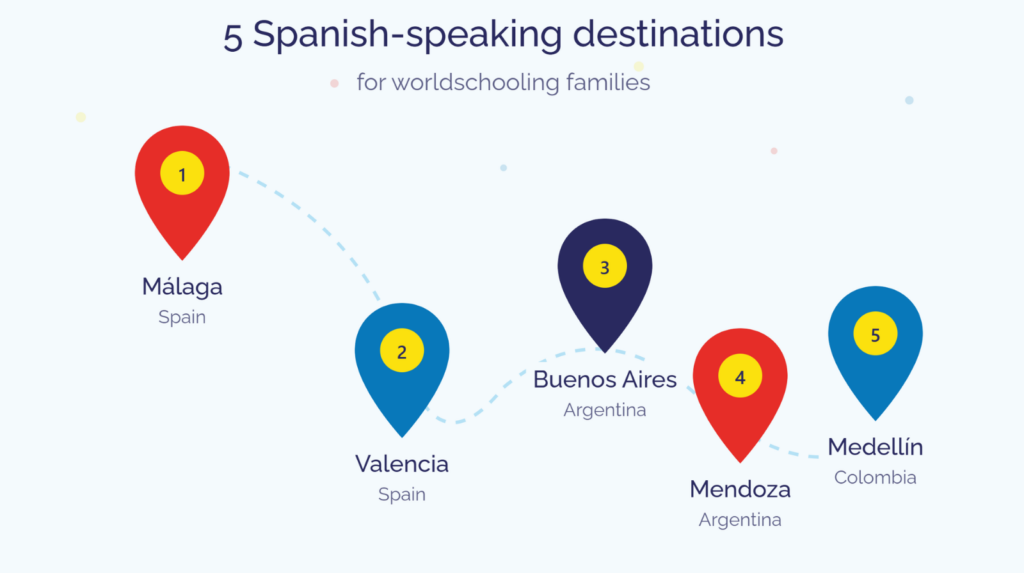
1. Málaga, Spain
Málaga is where we now run our own Spanish immersion trips for home-educated children and their families, so I know this one inside out (you can read more about that journey here).
It’s a genuinely gentle starting point for a first Spanish immersion experience — beaches, history, an easy pace, and excellent transport links into the rest of Andalucía if you want to explore further afield. Families on our trips stay right on the seafront at Playa de Misericordia, with lessons in the morning and the city — the Alcázaba, the markets, the chiringuitos — as the afternoon classroom.
Andalusian Spanish has its own personality too. Locals tend to soften or drop the final “s” in words, so gracias becomes something closer to gracia’ — a small thing, but it’s exactly the kind of real-world listening practice no textbook gives you.
2. Valencia, Spain
Valencia doesn’t get talked about as much as Barcelona or Madrid, but for families it’s one of the most liveable Spanish cities going. It combines a proper city — culture, architecture, a serious food scene — with beaches and green space (the old riverbed park, the Turia gardens, cuts straight through the centre), and a noticeably more relaxed pace than Spain’s bigger cities.
It’s also a place where older children can start to do things independently — walk to a shop, navigate a metro stop — while you’re still firmly within easy reach. That small taste of independence, in Spanish, is worth a lot.
3. Buenos Aires, Argentina
This one will always be personal. Buenos Aires is where I spent years of my life, and it’s a city that gives families an enormous amount: a genuinely world-class food culture, parks and outdoor life everywhere you look, and a city that takes music, dance and tradition seriously as part of everyday life rather than performance for tourists.
Buenos Aires also does something useful for a worldschooling family’s understanding of the language itself: it shows children that Spanish isn’t one culture. Argentine Spanish — particularly the slang known as Lunfardo, which grew out of the immigrant neighbourhoods of Buenos Aires — sounds, and feels, completely different from the Spanish of Spain or Mexico. That’s a brilliant, concrete lesson in how language is shaped by history and place, not just grammar.
4. Mendoza, Argentina
If Buenos Aires is the city, Mendoza is the slower, mountain counterpoint — and it’s where I actually lived and built a life for years, including running a travel agency and training tour guides.
Mendoza sits in the shadow of the Andes, in a province so dry it shouldn’t really support a city at all — yet a clever, centuries-old irrigation system of acequias channels meltwater from the mountains through tree-lined streets and parks, turning what’s technically desert into a green, walkable city of around a million people. It’s also genuinely close to serious outdoor adventure: Aconcagua, the tallest peak outside the Himalayas, is right on the doorstep.
For families, that combination — manageable city, real community feel, mountains and vineyards on the doorstep — makes Mendoza an excellent base for slowing right down and letting Spanish settle in over weeks rather than days.
5. Medellín, Colombia
Medellín surprises people, and that’s part of its appeal. Once known for all the wrong reasons, the city has transformed itself over the last couple of decades — areas like Comuna 13, previously associated with conflict, are now known for street art and community-led culture — and it’s earned its nickname, the city of eternal spring, thanks to a climate that barely shifts year-round.
It’s also a city with serious art in its DNA. Fernando Botero, Colombia’s most famous artist, was born here, and Plaza Botero in the city centre is scattered with his unmistakable, larger-than-life bronze sculptures — free to wander among, right next to the Museo de Antioquia, which holds the largest collection of his work anywhere. I first came across Botero’s work travelling through central Colombia years ago, and it’s stayed with me since; it’s exactly the kind of real, hands-on cultural moment that turns a holiday into actual learning. For a family, an afternoon in that plaza is an art lesson, a history lesson and a Spanish lesson rolled into one — and nobody has to sit still at a desk for any of it.
Don’t chase perfection — chase connection
The “best” destination isn’t the one with the cheapest flights or the longest attractions list. It’s the one where your family can actually connect — because language learning is, in the end, about relationships. Spanish comes alive when your children have a real reason to use it.
Before you travel
- Build some basic Spanish confidence as a family
- Learn useful everyday phrases together
- Introduce your children to a little of the culture and history first
While you’re there
- Encourage small interactions — ordering, asking, chatting
- Build a routine rather than rushing between sights
- Let your children’s curiosity lead some of the time
When you’re home
- Keep the momentum going with regular lessons, books and conversation
A trip can spark a love of Spanish. Consistent learning afterwards is what makes that spark grow — and that’s exactly what we help families do at Adventures in Spanish, combining structured Spanish learning with real-world experience so children don’t just learn Spanish, they use it.
Ready to put it into practice? Explore our Spanish classes for home-educated children or join us on our next Spanish immersion trip to Málaga.
