
Being able to talk about likes and friends in Spanish is one of the fastest ways learners to move beyond isolated words and into real communication, which is exactly the kind of practical, confidence-building Spanish we focus on at Adventures in Spanish. When learners can express opinions and talk about people they care about, Spanish stops feeling like a subject and starts feeling like a skill. Whether you’re supporting a child learning Spanish at home, or you’re an adult learner yourself, this is the kind of language that makes Spanish immediately useful.
Why Talking About Spanish Likes and Dislikes Builds Confidence
As a Spanish learner o ne of the first things you want to talk about is what you like and don’t like. Food. Hobbies. Sports. Music. (And very often, what you definitely don’t like.)
In Spanish, this starts with a few high-frequency phrases that are perfect for beginner Spanish conversation:
- Me gusta… (I like…)
- No me gusta… (I don’t like…)
- Me encanta… (I love…)
These structures are incredibly powerful because they’re easy to remember and endlessly reusable. Plus, you can personalise them straight away:
Me gusta el fútbol.
Me encanta la música.
No me gustan las verduras.
For families learning Spanish at home, this is a big win. Children aren’t just repeating vocabulary — they’re expressing real opinions. That emotional connection helps language stick and builds confidence far faster than lists and worksheets ever could.
Teaching Spanish likes and dislikes early also gives learners a sense of control over the language. Young learners can already say something meaningful, even with limited vocabulary, and that feeling is hugely motivating.
How can you talk about your friends in Spanish?
Once you can talk about what you like, the next natural step is talking about your friends in Spanish. This is where Spanish becomes social — and much more fun.
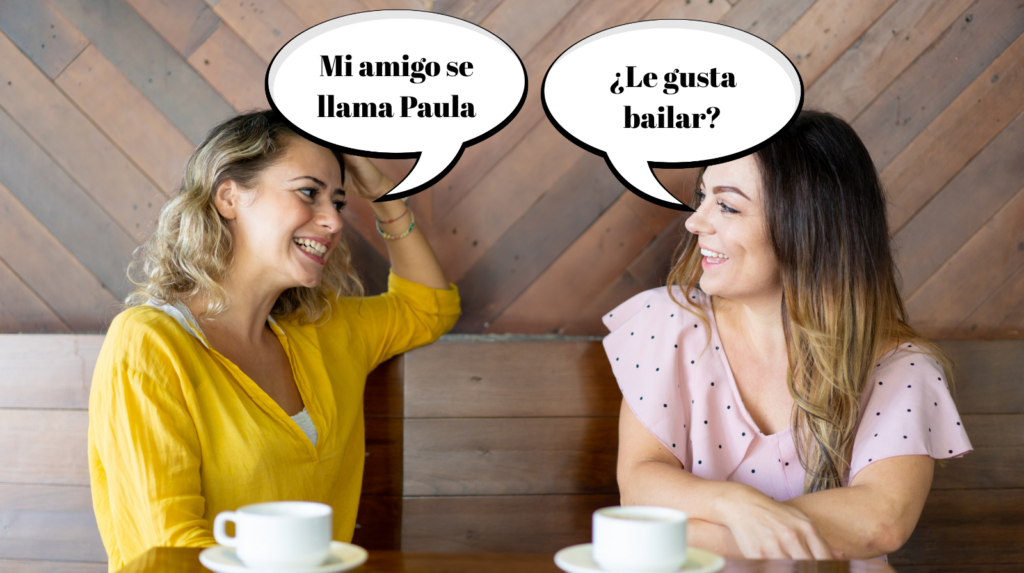
Simple sentence starters make this accessible even for beginners:
- Mi amigo / Mi amiga… (My friend…)
- Se llama… (He/She is called…)
- Tiene … años (He/She is … years old)
- Le gusta… (He/She likes…)
These allow you to build short but meaningful sentences such as:
Mi amigo se llama Pablo.
Tiene once años.
Le gusta el fútbol.
This kind of language works especially well if you’re an independent learner, learning from home because it’s rooted in your real live. You’re talking about actual friends, not fictional textbook characters, which keeps engagement high and makes Spanish feel relevant.
It also introduces an important conversational skill: changing me gusta to le gusta when talking about someone else. You’ll absorb this naturally when it’s used in context, rather than explained to death.
Being able to talk about Spanish likes and dislikes and friends in Spanish gives you the foundations for real beginner Spanish conversation. It’s personal, practical, and empowering — especially for families learning Spanish at home.
And that’s the goal: real communication, from the very beginning, built around the things that you actually care about. ???
