

This one comes up constantly with adult learners, and I completely understand why — it seems like it should be straightforward. You know puedo means “can I” and tener means “to have,” so surely puedo tener means “can I have”?
Lo siento — I’m afraid not.

This is one of those cases where Spanish and English just don’t map onto each other the way you’d expect. “Can I have” as a single phrase doesn’t really exist in Spanish. Instead, what you say depends on what you’re asking for and how you’re asking for it.
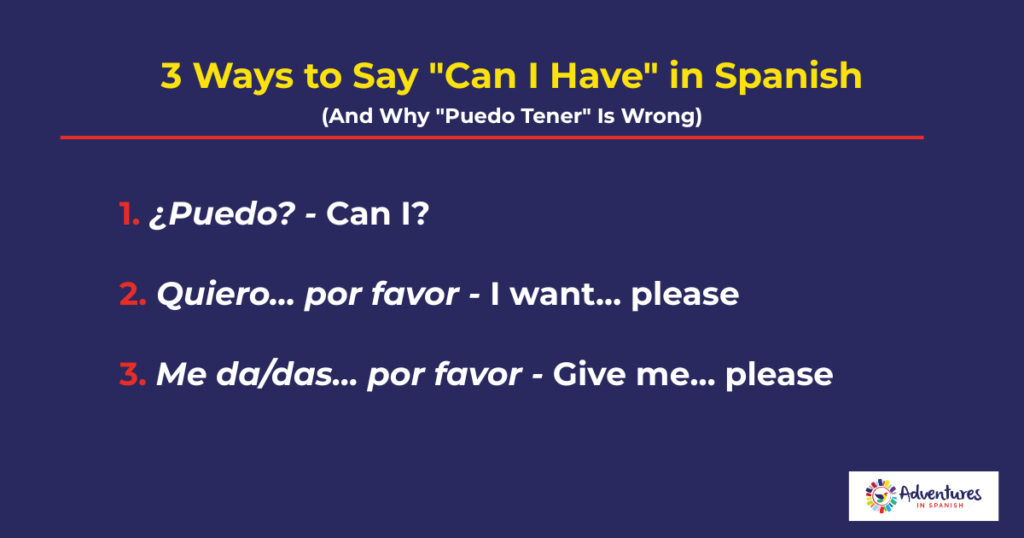
Here are the three ways to do it — all of which work, all of which sound natural to a native speaker.
1. “Can I have” as “Can I?” — ¿Puedo?
The simplest option, and perfect for everyday situations where you’re pointing at something specific.
¿Puedo? — can I?
That’s it. You don’t need to name the thing if it’s obvious from context. You’re in your hotel reception, you want one of the leaflets on the desk — catch the receptionist’s eye, point to the leaflet, and say ¿puedo? They’ll say sí, you say ¡gracias!, everyone’s happy.
Puedo comes from the verb poder (to be able to/can), conjugated in the first person. You can extend it if you want to be more specific — ¿puedo coger uno? (can I take one?) — but the single word works perfectly well in most casual situations.
2. “Can I have” as “I want” — Quiero
This one surprises people because it sounds demanding in English. “I want the prawns” feels rude; “can I have the prawns please” feels polite.
In Spanish, it works differently. Quiero (I want, from the verb querer) used with por favor at the end is a perfectly natural, polite way to order or request something — restaurants, bars, shops, anywhere.
Quiero las gambas, por favor — can I have the prawns please.
Add por favor and it’s a request, not a demand. This is probably the most useful of the three for everyday situations — it’s what you’ll hear native speakers using constantly.
3. “Can I have” as “Give me” — Me da / Me das
The verb dar (to give) is your third option, and it’s the one that sounds most fluent when used correctly — though you need to pay attention to your pronouns.
The key phrase is me da or me das, which literally translates as “can you give me” — far more natural in Spanish than it sounds in direct English translation.
- Me das — when speaking to someone informally (tú)
- Me da — when speaking to someone formally (usted)
So in a formal restaurant: me da la carta, por favor — can I have the menu please.
In a bar with a friend: me das una cerveza — can I have a beer.
Getting the da/das distinction right is one of those small things that makes a noticeable difference to how natural your Spanish sounds.
Quick Reference
| Situation | What to say | Literal meaning |
|---|---|---|
| Pointing at something obvious | ¿Puedo? | Can I? |
| Ordering food or drink | Quiero… por favor | I want… please |
| Asking someone to give you something | Me da/das… por favor | Give me… please |
If Spanish grammar is starting to click for you, it’s worth understanding the difference between ¿cómo estás? and ¿cómo eres? — two questions that look almost identical but mean completely different things, and come up constantly in everyday conversation.
Hear It in Action
Knowing the right phrase is one thing — saying it with confidence is another. I put together a short YouTube video so you can hear exactly how these sound in spoken Spanish. Watch it here.
And if you’d like to get to the stage where requests like these come out automatically — without having to run through the options in your head first — our adult Spanish classes run throughout the year in North Wales and online. Small groups, real conversation practice, and tutors who’ve spent years actually using Spanish in Spanish-speaking countries.